
Last updated October 16, 2026
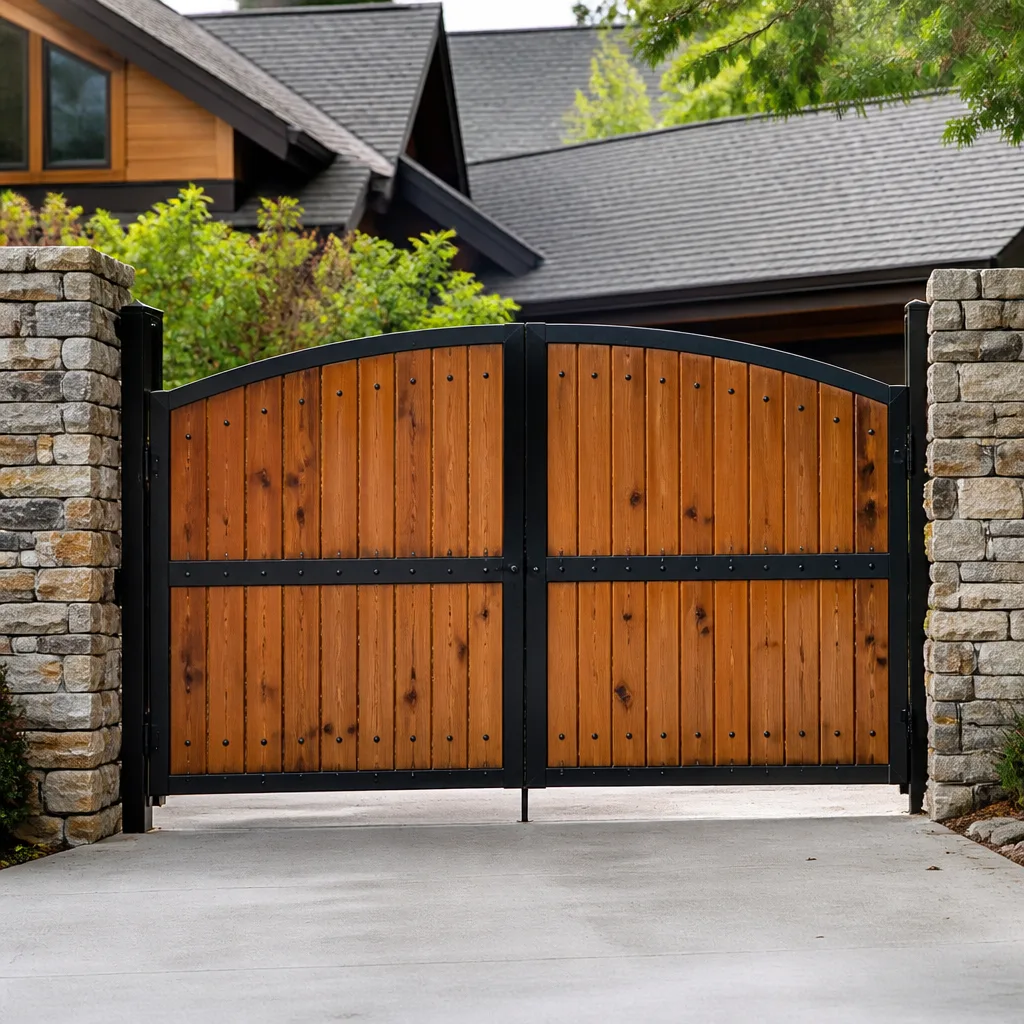 Wood & steel frame
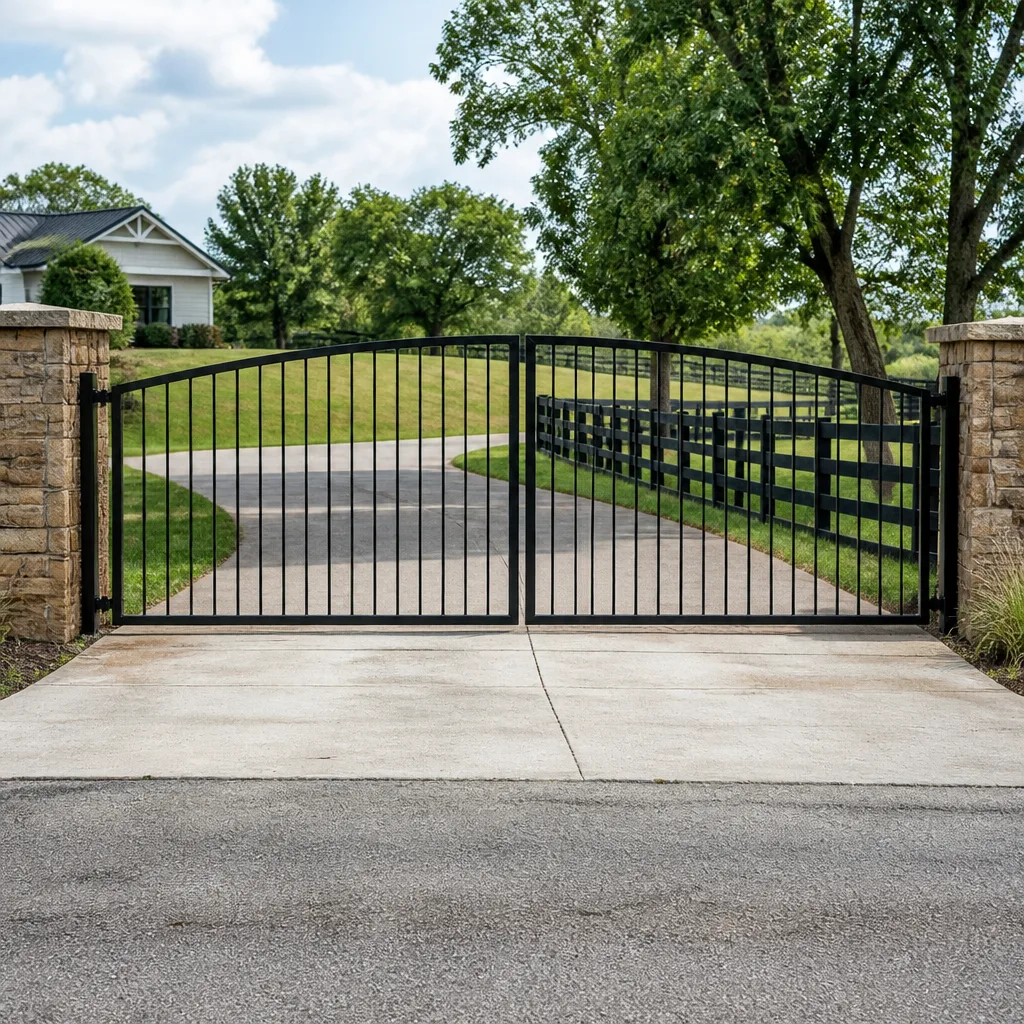 Farm & ranch
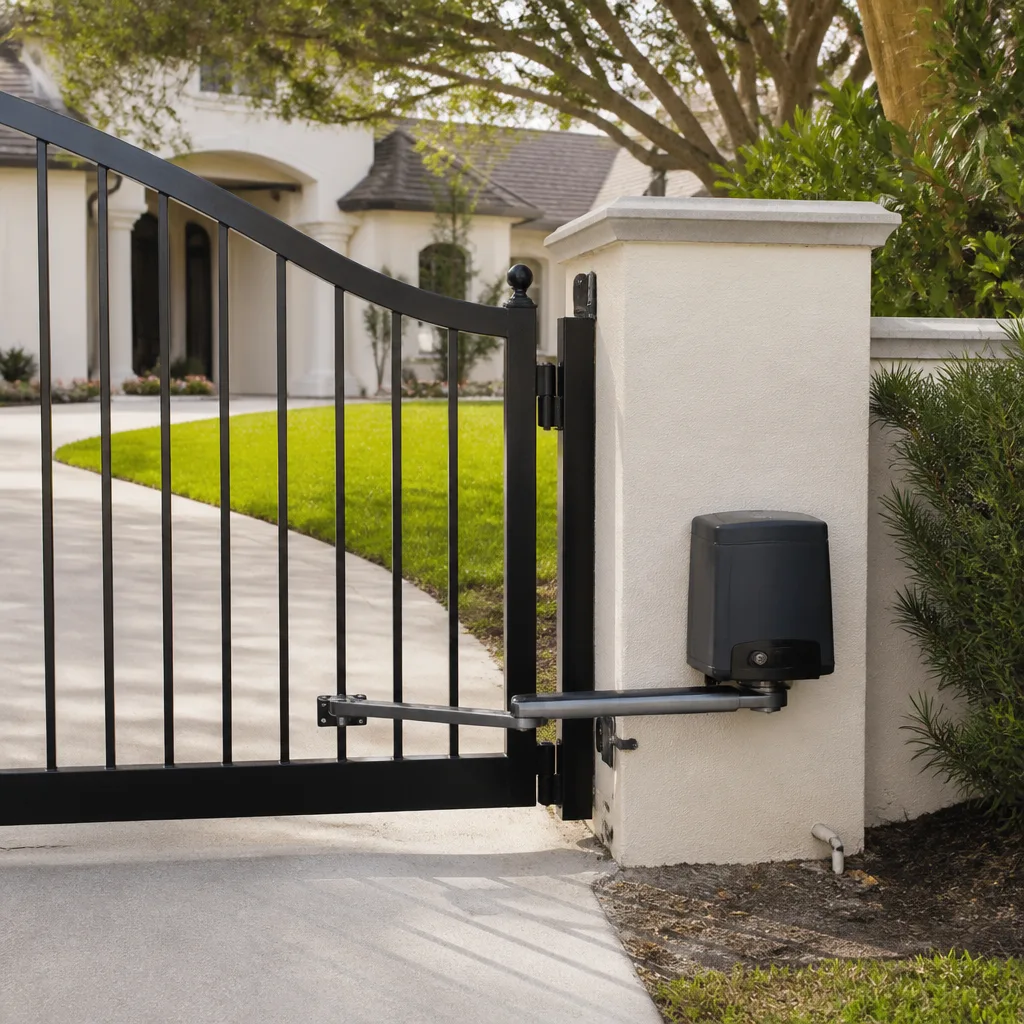 LiftMaster operators
Free on-site gate assessment - hinges, posts, and your LiftMaster or Nice gate operator checked before anything is quoted
The assessment is free and the quote is the invoice.
Get your free estimateThe Complete Guide to Gate Repair in Orange County
Here’s the stat nobody publishes: in our Orange County service record, roughly four out of ten gate repair calls turn out to be a structural or alignment problem that was misdiagnosed as a motor failure on a previous visit by another company. The homeowner paid for a new operator, and the gate still dragged, sagged, or bound against the post within months. This guide is written to stop that cycle. You’ll learn how Orange County’s specific microclimates stress gates differently by city, which parts fail first on each gate type, and how to tell a $200 hinge fix from a $2,000 operator replacement before anyone touches a tool.
Quick Answer
Gate repair in Orange County typically costs between $175 and $650 for most common issues like hinge replacement, sensor alignment, or limit-switch adjustments, while a full operator swap usually runs $1,400 to $3,200 with labor. The single most important step is diagnosing whether you have a mechanical problem, an electrical problem, or a structural problem, because each has a completely different repair path and price. Portcullis our Gate Repair services gives every customer a written price before any work starts, so you’ll know the number before a single bolt is turned.
Styles & brands we work with
Table of Contents
- Gate Types in Orange County and Their Most Likely Failures
- How Orange County Microclimates Create Different Gate Problems
- Operator Failure vs. Structural Failure vs. Access-Control Failure
- What Gate Repair Actually Costs in Orange County
- When to Repair vs. When Replacement Math Makes Sense
- What the Written-Price Promise Actually Means in Practice
- What You Can Safely Check Yourself (and What You Should Never Touch)
- Common Mistakes to Avoid
Gate Types in Orange County and Their Most Likely Failures
Before you can understand your gate repair, you need to know what kind of gate you actually have. The failure pattern is different for every type, and so is the fix. Treating every gate the same is how small problems become expensive ones.
Slide Gates (Track and Cantilever)
Slide gates are common across Orange County because they work well on flat lots and don’t need room to swing. A track slide gate rolls on wheels along a metal rail set into the driveway, while a cantilever gate rides above the ground on rollers mounted to the gate frame, with no track to trip over or clog.
The track version fails most often at the wheels and the track itself. Sand, gravel, and leaf debris from Orange County’s Santa Ana winds collect in the track channel, and every cycle grinds that grit into the wheel bearings. We regularly see slide gates in Anaheim and Fullerton where the wheels have worn flat on one side, which makes the gate shudder and eventually stall. The fix is usually wheel replacement and track cleaning or re-bedding, far cheaper than an operator swap.
Cantilever gates fail differently. Because the entire gate hangs on side rollers, any settling of the posts changes the gate’s angle. The symptom looks electrical because the gate slows down or trips its obstruction sensor, but the actual cause is mechanical: the rollers are binding. A good technician checks the post alignment before touching the motor.
Swing Gates (Single and Double Leaf)
Swing gates are the most common gate style in Orange County residential neighborhoods, especially in older areas like Orange, Santa Ana, and Garden Grove. They hinge on posts and swing open either manually or with an actuator, the motorized arm that physically pushes the gate.
The weak points are predictable. Hinge pins wear, especially on heavy gates, and the gate begins to sag. The sag transfers weight onto the actuator, the opener, which now has to lift the gate slightly every time it moves. Actuators are not designed to lift; they’re designed to push. A sagging gate burns out actuators far faster than normal wear ever would. In Anaheim Hills, where driveways slope, we see this constantly: the gate sags toward the low side, the actuator strains, and the homeowner replaces the actuator twice before anyone says the word hinge.
Wood swing gates add a second variable: moisture. Coastal Orange County air keeps wood gates slightly swollen through the marine-layer months, and inland the Santa Anas dry them out. That cycle loosens joints and warps the gate frame over a few seasons.
Material Differences: Steel, Aluminum, Wrought Iron, Wood
Steel gates are strong and heavy, which means their failures are usually structural, broken welds, sagging frames, and hinge strain. Aluminum gates fail less often due to rust, but they’re softer, so hinge points can elongate and create the same sag problem in a different way. Wrought iron shares steel’s weight profile and adds ornate sections that trap moisture at the joints. We see wrought iron gates in older Orange County neighborhoods like Floral Park and Old Towne Orange where the decorative scrollwork has rusted through at the bottom welds, leaving the top sections stable but the lower frame structurally compromised.
Wood gates are the lightest and most forgiving for operators, but the material itself degrades fastest. Rot at the hinge mounts is the classic failure, and the repair usually involves cutting out the rotted section, splicing in new wood, and remounting the hinge with longer fasteners.
How Orange County Microclimates Create Different Gate Problems
Orange County is 948 square miles with at least three distinct climate zones, and your gate lives in only one of them. A gate repair that works in Huntington Beach may not be the right approach for a gate in Yorba Linda, because the failure modes are different.
The Coastal Belt: Huntington Beach, Newport Beach, Costa Mesa, Seal Beach
The marine layer brings salt air and high humidity, especially overnight and in the early morning. Salt air is corrosive, and it attacks metal gates and hardware at a measurable rate. Gate hinges, bolts, and operator mounts along the coast rust through faster than the same parts five miles inland. Powder-coated steel resists this well, but any scratch through the coating becomes a starting point for rust.
Coastal gate repairs skew toward corrosion-related problems: rusted hinge pins, seized bolts, and corroded electrical connections inside operator housings. The electrical issues are particularly sneaky because the operator may work intermittently, making the problem look like a bad circuit board when it’s actually a corroded terminal block.
The Inland Basin: Anaheim, Fullerton, Orange, Santa Ana, Garden Grove
Inland Orange County runs hotter and drier in summer, with Santa Ana winds in autumn that can push temperatures up and keep humidity near single digits. The dry air pulls moisture out of wood gates, causing shrinking, cracking, and loosened joints. Wood gates in the inland basin need hinge retightening and frame adjustment far more often than coastal wood gates of the same age.
Dust is the other inland factor. The Santa Anas carry fine dust that coats operator gears and limit switches. Limit switches are the small components that tell the operator where to stop the gate. When dust builds up on the contacts, the gate stops short or overtravels, sometimes slamming into the post. Cleaning the limit switches and adjusting them is a straightforward repair that takes less than an hour.
The Foothills: Anaheim Hills, Yorba Linda, Villa Park, North Tustin
Foothill properties add slope and wind to the equation. Gates on sloped lots are fighting gravity every time they move, which means the operator works harder than it was designed to. Actuators on uphill-opening gates wear out faster, and hinges on downhill-facing gates carry more static load than the same hinge on flat ground.
We also see more thermal expansion problems in foothill gates. Steel expands in the day’s heat and contracts at night, and over years that cycle loosens anchor bolts at the post bases. A loose post mimicks a failing operator, because the gate binds and the motor trips its obstruction circuit. The repair is re-anchoring the post and re-aligning the gate, not replacing the operator.
Operator Failure vs. Structural Failure vs. Access-Control Failure
Every gate has three systems working together: the structural assembly, the operator, and the access control. Mixing them up is the most expensive mistake in gate repair, because each has its own repair path and price range. Here’s how to tell them apart.
Structural Failure: The Gate Itself
Structural problems are physical: sagging, binding, broken welds, rotted wood, bent track sections, worn wheels, and misaligned posts. The gate may still open and close, but it scrapes, shudders, makes grinding noises, or has visible wear marks.
The tell is usually visual and audible. A structural problem sounds mechanical, metal on concrete, creaking hinges, a gate that visibly sits lower on one side. The repair path is physical too: hinge replacement, weld repair, track re-bedding, post re-anchoring. These repairs typically cost less than operator replacements, which is why a correct diagnosis saves money.
Operator Failure: The Motor and Drive System
The operator is the motor, gearbox, circuit board, limit switches, and related drive components. Operator failures show up as a gate that won’t move at all, moves only one direction, stops mid-cycle, or makes a humming sound without moving.
The key diagnostic distinction: if the gate moves easily by hand when the operator is disengaged, the structure is probably fine and the operator is the problem. If the gate is hard to move manually, you have a structural issue that is overloading the operator. Replacing the operator without fixing the structural problem guarantees the new operator will fail early too.
Access-Control Failure: Keypads, Remotes, Sensors, and Intercoms
Access control includes the keypad, remote transmitters, loop detectors in the driveway, photoelectric safety sensors, and any intercom or phone-entry system. These failures show up as a gate that works perfectly but won’t respond to a specific input. The remote works but the keypad doesn’t, or the gate opens automatically but won’t respond to the exit wand.
Access-control repairs are often the least expensive and the fastest, but they’re also the most likely to generate repeated service calls, because the first fix frequently replaces the wrong component. A keypad that doesn’t work might be a bad keypad, a bad wire, or a failing circuit board in the operator. The order you check matters.
Here’s the diagnosis sequence we follow on every Portcullis Gate Repair Orange County call:
- Disengage the operator and test the gate by hand. Hard to move means structural; easy to move means look at the operator.
- If the gate moves fine manually, test the operator with the manual controls, not the remote. This isolates the access control from the motor.
- If the operator works manually but not by remote or keypad, test each access-control input separately to find which one failed.
- If both structure and operator check out, look at power and safety sensors, especially the photoelectric eyes.
What Gate Repair Actually Costs in Orange County
Gate repair pricing in Orange County ranges from around $175 for a simple service call with a minor adjustment to more than $3,000 for a full operator replacement on a heavy slide gate. The range is wide because gate types, materials, and failure modes are all different. Here’s a Gate Repair Cost Breakdown: The Orange County Homeowner’s Reference for 2026 and what other reputable Orange County gate companies charge, based on current market rates.
Every price below is the total you should expect to pay for parts and labor. Written estimates should always be provided before work begins, and you should never accept a verbal quote followed by a surprise invoice at the end.
- Service call and diagnostic: $75 – $150, often credited toward the repair if you proceed. At Portcullis Gate Repair Orange County, the price is quoted before we start, and you approve it in writing.
- Hinge replacement (single gate): $175 – $350 depending on gate weight and hinge type. Heavy steel and wrought iron gates run the high end.
- Limit switch adjustment or replacement: $125 – $250. This is one of the least expensive operator repairs and one of the most commonly needed.
- Photoelectric sensor replacement or realignment: $150 – $325. Sensors fail from age, vibration, or being knocked out of alignment by weather.
- Track cleaning, re-bedding, or wheel replacement (slide gates): $250 – $600. Re-bedding a track means resetting it in concrete or asphalt, which adds labor.
- Actuator replacement (swing gates): $600 – $1,400 for most residential units from brands like LiftMaster, FAAC, and Mighty Mule, installed. Heavy custom gates or long driveways can push this higher.
- Full operator replacement (slide or swing): $1,400 – $3,200 for equipment and installation. This is the range for residential operators from brands like LiftMaster, FAAC, Elite, and BFT. Commercial operators on large gates can exceed this.
- Circuit board replacement: $300 – $750. Circuit boards are brand-specific, so the price depends on your operator’s manufacturer.
- Post re-anchoring or replacement: $400 – $1,200. This is a structural job that requires digging, concrete, and re-alignment.
- Wood gate frame repair (rot or warp): $300 – $800 depending on the extent of the damage and whether the gate needs reframing.
Orange County pricing is slightly higher than national averages because labor rates in Southern California run above the national norm, and many properties here have larger, heavier gates than the typical suburban installation. The good news is that accurate diagnosis keeps costs down. A $200 hinge replacement fixes what a $1,800 operator replacement never will, if the actual problem is structural.
Read our detailed breakdown on the Gate Repair in Orange County page for more specifics on pricing by repair type.
When to Repair vs. When Replacement Math Makes Sense
The repair-versus-replace decision comes down to a simple equation: how much have you spent on repairs in the last two years, and what does a new gate or operator cost relative to that number? Most gate companies in Orange County won’t tell you when replacement is the smarter play, because replacement isn’t what they came out to sell. See our DIY vs Professional Gate Repair: The Orange County Homeowner’s Decision Guide for help deciding. Here’s the honest math.
A Good Repair Genuinely Extends Gate Life When:
- The gate structure is sound and the failure is isolated to one component, like a hinge, a sensor, or a limit switch.
- The repair cost is less than 30% of the replacement cost for that component or system.
- The gate is less than 10 years old and the frame, posts, and welds are in good shape.
- The operator is a quality brand, like LiftMaster or FAAC, and the issue is a replaceable part rather than systemic failure.
Three Repairs in Two Years Usually Means Replacement Is the Better Bet
If you’ve had three separate repairs in a two-year span, the repair bills are already approaching the cost of replacement, and the underlying issue is probably chronic: an undersized operator struggling with a heavy gate, structural wear in multiple areas, or accumulated corrosion from Orange County coastal air. At that point, the honest recommendation is to stop paying for repairs and invest in a new installation.
The replacement math for a typical residential swing gate with a new operator and actuator looks like this:
- Year one repair spend: $400 for a hinge and track adjustment
- Year two repair spend: $900 for an actuator and limit-switch replacement
- Year three projected: $600 – $1,200 for circuit board or motor failure
- Total three-year spend: $1,900 – $2,500, with an unreliable gate
- New complete gate and operator installation: $3,000 – $6,500 for most residential Orange County gates, with a 365-Day Done Right Promise backing the install.
When the repair total approaches two-thirds of the replacement cost and the gate is still failing, replacement is the better financial decision. For full installation details, see our Gate Installation in Orange County page.
What the Written-Price Promise Actually Means in Practice
Most gate companies in Orange County operate on the same model: the technician arrives, takes the gate apart, and then builds the quote from a position of leverage. You’re standing there with a disassembled gate, the truck is running, and the number keeps moving. That’s why the Kingswell Guarantee exists, and why every Portcullis Gate Repair Orange County job starts the same way: with the price in writing before any work begins.
The Kingswell Way: Five Plain-English Commitments
- Say the price before the work. You get a written quote before we touch anything. If the quote changes because we discover something unexpected, we stop and get written approval before continuing.
- Show up in the window we gave. You’ll get a real arrival window when you book, not a vague “sometime between 8 and 6.” Our technicians arrive in uniform and in a marked vehicle, and you’ll know their name before they pull into the driveway.
- Leave the place cleaner than we found it. No loose bolts, no grease marks on the driveway, no debris from the repair left behind.
- Put the guarantee in writing. Every repair invoice includes the written Kingswell Guarantee. If the repair fails within 365 days, we return and fix it at no charge, under the 365-Day Done Right Promise.
- Come back if it fails. No phone tag, no argument. You call, a live person answers, and we schedule the return visit.
The written-price promise also means there’s no “diagnostic fee waived if you book today” pressure. We don’t use scarcity tactics. The diagnostic fee is straightforward and disclosed when you book, and it’s credited toward the repair if you proceed. The price is the price, and it’s in writing before a single bolt is turned.
Every Portcullis location is an independently owned Kingswell company, held to the same written standard. Not a franchise promise, a written one. The same Kingswell Guarantee applies whether you’re calling from Huntington Beach or Anaheim Hills.
What You Can Safely Check Yourself (and What You Should Never Touch)
Some gate checks are safe and useful, and doing them before you call can actually speed up the repair and lower your bill. For more guides & resources, explore our blog. Others are genuinely dangerous. Here’s the line.
Safe to Check Yourself
- Visual track inspection for slide gates: Look for debris, rocks, or compacted dirt in the track. Clear the obvious stuff with a broom or shop vacuum. Don’t use a pressure washer near electrical components.
- Visual hinge inspection for swing gates: Look for visible sag, rust, or loose fasteners. If the gate has shifted and left a scrape mark on the driveway, take a photo. That’s useful diagnostic information.
- Remote battery replacement: If the remote is intermittent, replace the battery before calling. It solves a surprising percentage of remote issues.
- Photoelectric sensor check: Most photo eyes have a small indicator light. If it’s dark or blinking, the sensors may be misaligned or blocked. Gently wipe the lenses clean and see if the light returns.
- Keypad battery and code check: If the keypad is unresponsive, check the battery if it’s wireless, and try the code slowly. Many keypads fail from old batteries, not bad wiring.
Do Not Touch These Yourself
- Operator internals: The operator contains capacitors that store charge even when the unit is unplugged. A capacitor can discharge enough electricity to hurt you minutes after the power is off.
- High-tension components: Some gate systems use counterweight or spring-assist mechanisms. A gate spring under tension stores enormous energy. If it releases while you’re adjusting it, the result can be catastrophic. Leave spring work to a trained professional.
- Structural repairs on heavy gates: Steel and wrought iron gates weigh hundreds of pounds. Lifting or propping a heavy gate without proper equipment is a crush injury waiting to happen.
- Post re-alignment or re-anchoring: Digging around gate posts requires knowing what’s underground: electrical conduit, irrigation lines, and in some Orange County areas, gas lines. Mistaking a post hole for a free dig can be dangerous and expensive.
- Any electrical wiring work: Gate operators run on line voltage in most cases. The low-voltage access-control wiring is safe enough, but the power supply side is not a DIY project.
If you’ve checked the obvious items and the gate is still misbehaving, or if the issue touches anything on the do-not-touch list, call a professional. The diagnostic call is less expensive than a hospital visit, and less expensive than replacing an operator you damaged by trying to fix the wrong thing.
Common Mistakes to Avoid
- Replacing the operator before checking the hinges. If the gate sags, the new operator inherits the same structural problem and fails early. Check the gate movement by hand first.
- Ignoring coastal corrosion until the gate stops moving. Huntington Beach, Newport Beach, and Seal Beach gates need preventive hinge lubrication and electrical connection checks more often than inland gates. Waiting until failure means a bigger repair.
- Using WD-40 on gate hinges. WD-40 is a solvent, not a long-term lubricant. It cleans the hinge and then evaporates, leaving the metal drier than before. Use a proper lithium or silicone grease.
- Pressure washing the operator housing. Water intrusion into the operator is a leading cause of circuit-board failure. The operator is weather-resistant, not waterproof.
- Buying a universal remote without checking compatibility. Not all operators use the same frequency or coding. Buying the wrong remote wastes money, and the gate still won’t open.
- Accepting a verbal quote and then paying a bigger invoice. The bill should match the written quote. If it doesn’t, that’s a red flag, and no reputable Orange County gate company should ever put you in that position.
- Letting a small hinge problem go for six months. A $200 hinge replacement becomes a $1,400 actuator replacement when the sag transfers weight onto the motor. Early repair is always cheaper.
See the difference
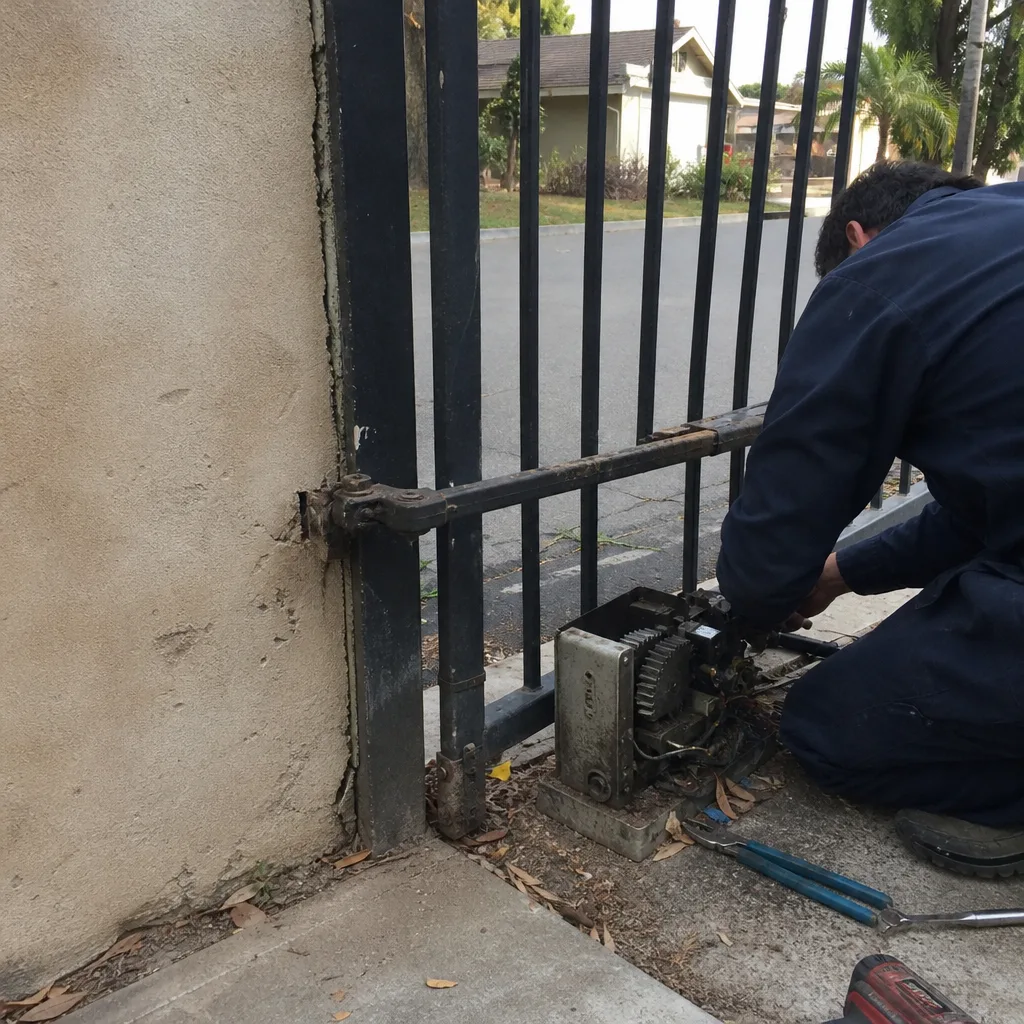 Before
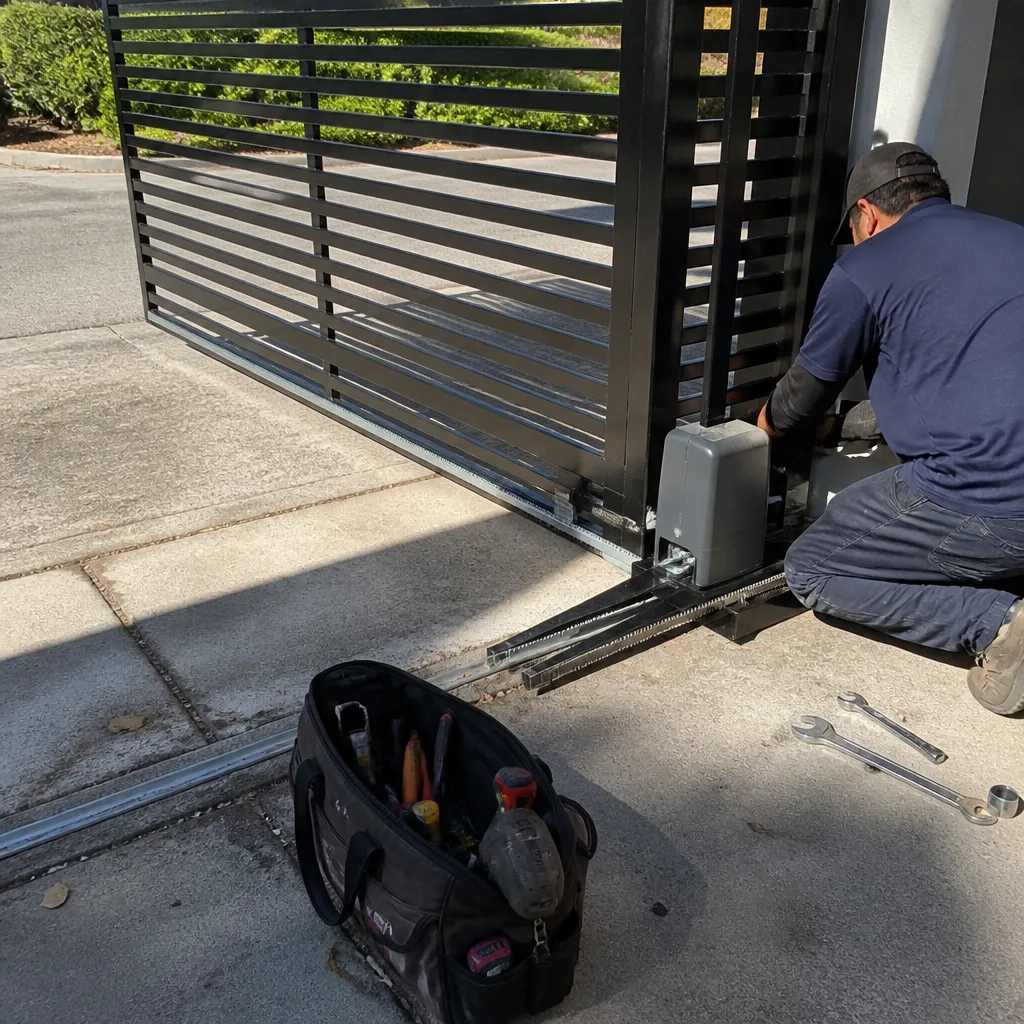 After
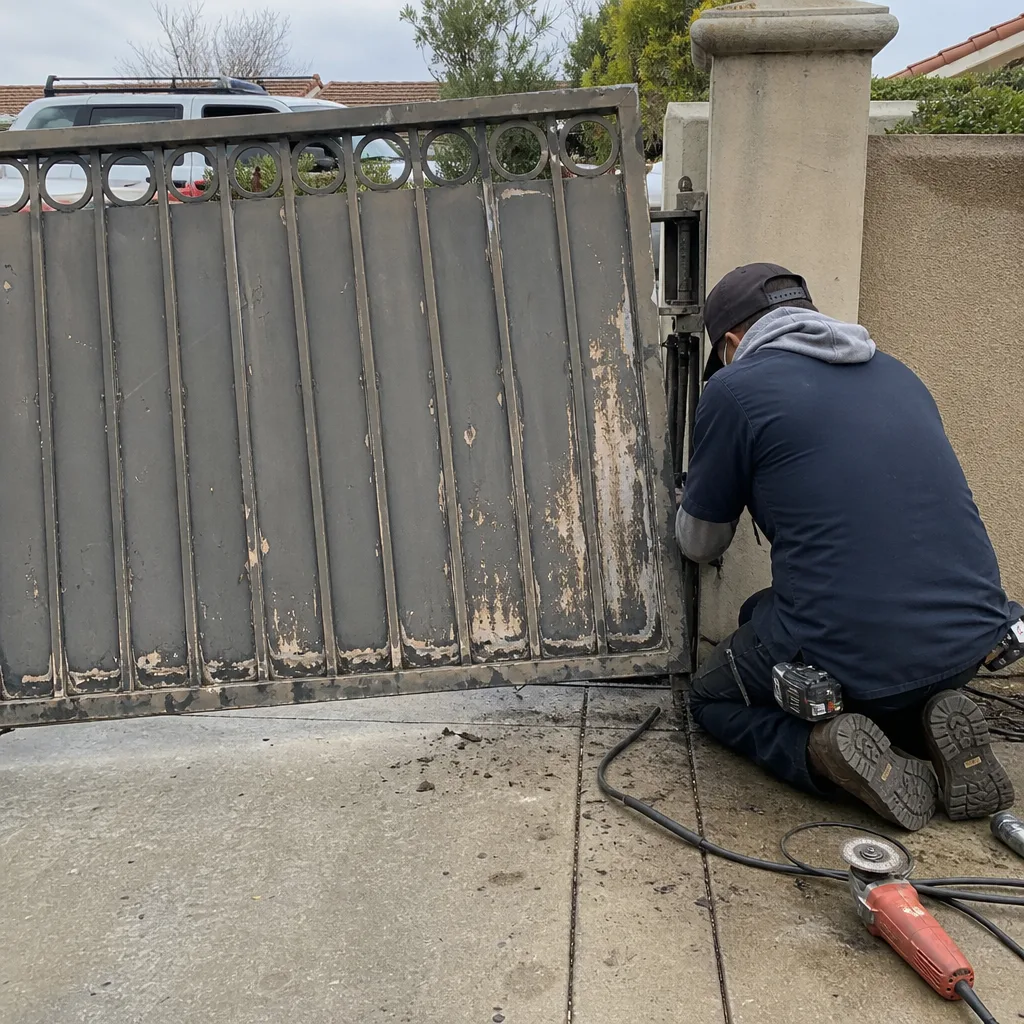 Before
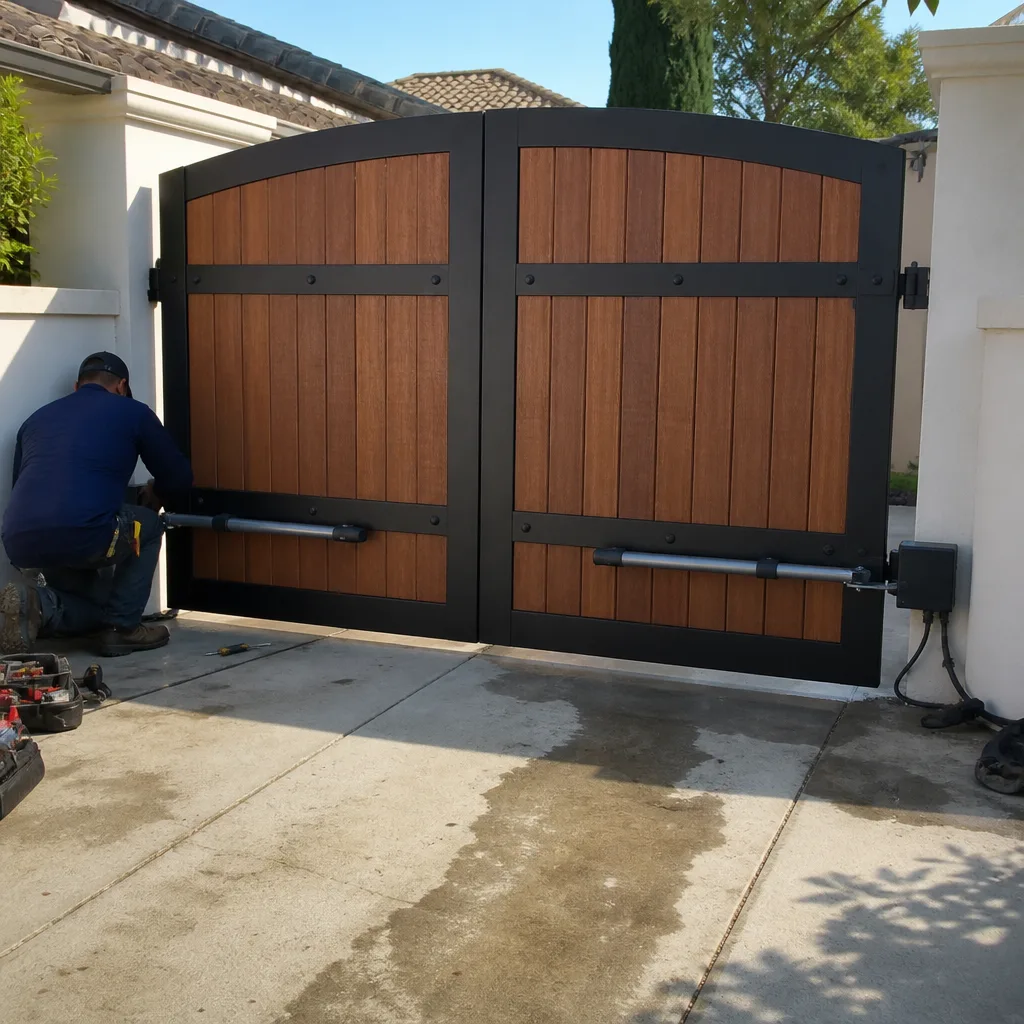 After
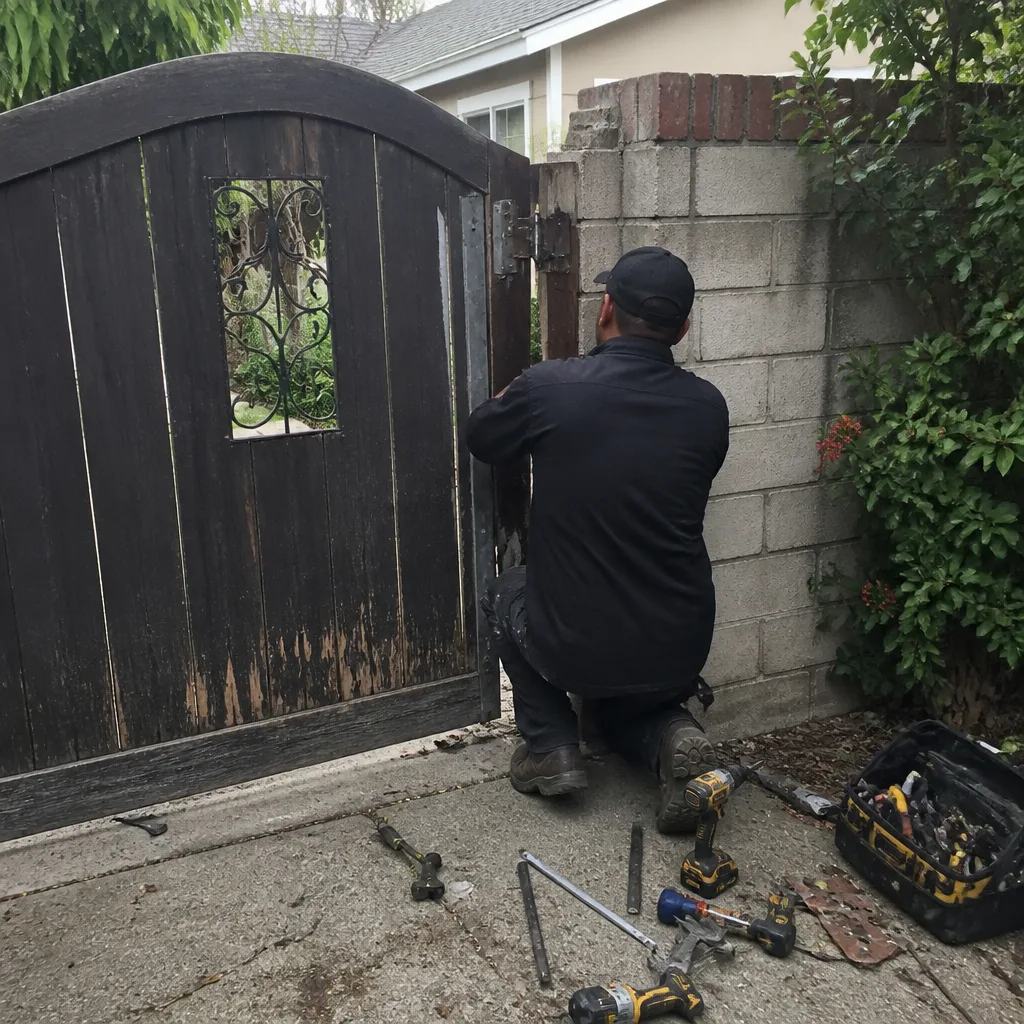 Before
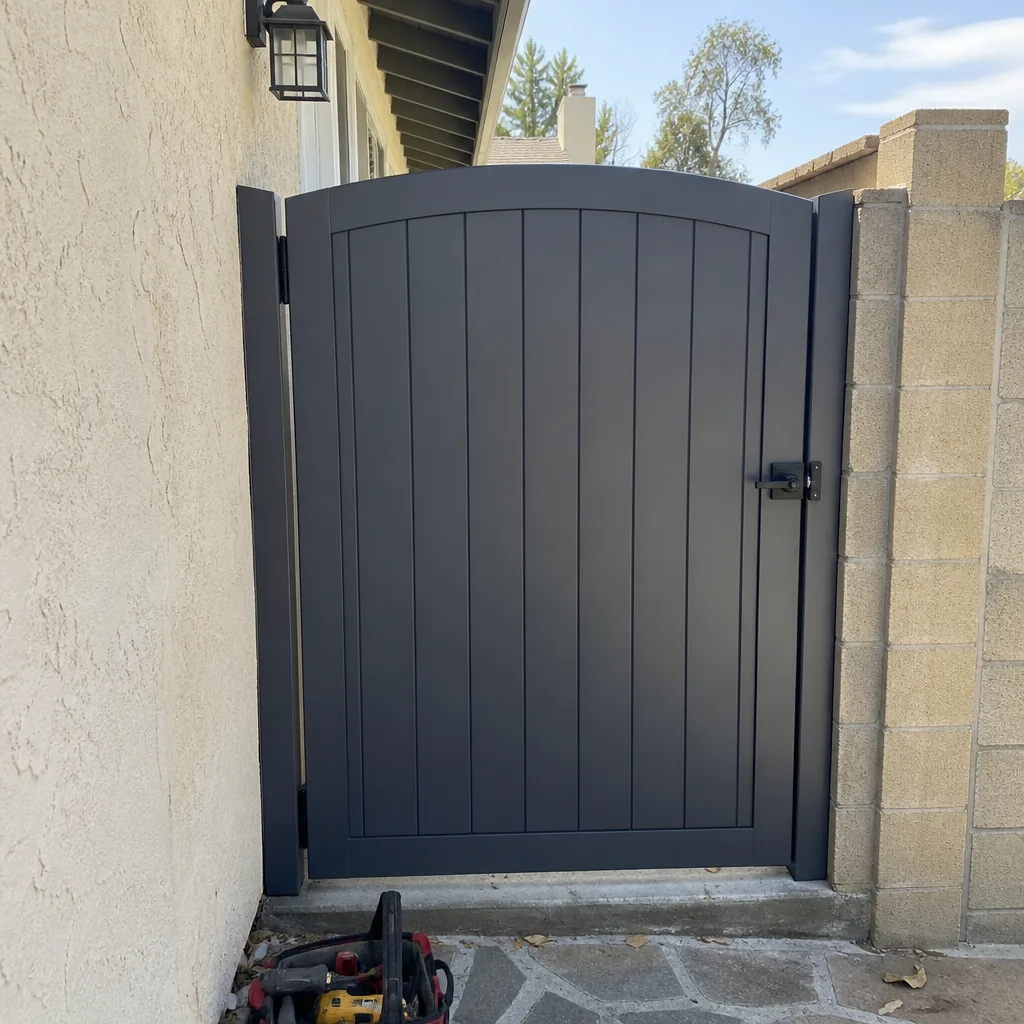 After
When to Call a Professional
Call a professional when the gate won’t move despite your simple checks, when it makes grinding or clicking noises, when it stops mid-cycle, when you see visible sag or a rusted-through section, or when anything on the do-not-touch list is involved. The moment you smell a burning odor from the operator or see smoke, shut off the breaker and call immediately, those are signs of electrical failure that can’t wait. Portcullis Gate Repair Orange County offers free estimates on all gate repair work in Orange County, with the price in writing before we start. A live person answers around the clock. Call (820) 529-0801.
Frequently Asked Questions
Gate repair in Orange County ranges from $175 to $650 for most common issues like hinge replacement, sensor realignment, and limit-switch adjustment, while full operator replacement runs $1,400 to $3,200. The range depends on your gate type, material, and whether the problem is structural, electrical, or access-control related. Call (820) 529-0801 for a free estimate with the price in writing before any work begins.
In most cases, yes. Portcullis Gate Repair Orange County maintains same-day availability for common repairs like hinge failures, sensor problems, and operator adjustments across Orange County. For major component replacements that require ordering a specific part, we’ll give you an honest timeline when you call. The phone is answered by a live person 24 hours a day, so you’ll know immediately what the schedule looks like at (820) 529-0801.
Disengage the operator using the manual release handle, usually a red or yellow handle on the operator unit, and try moving the gate by hand. If it’s hard to move, creaks, or scrapes, you have a structural problem. If it glides easily, the structure is fine and the operator or access control is the culprit. Our technicians perform this check first on every Portcullis Gate Repair Orange County visit, because it prevents expensive misdiagnoses.
Our technicians are trained on nine major gate-operator brands, including LiftMaster, FAAC, Elite, and Mighty Mule, along with BFT, Linear, Viking, Ghost Controls, and DoorKing. Because we carry common replacement parts for these specific brands on our service trucks, most repairs are completed in a single visit. If your operator is outside these brands, call (820) 529-0801 and we’ll tell you honestly whether we can source the parts.
Yes. Every repair carries the written Kingswell Guarantee, valid for 365 days, stamped on your invoice. If the repair fails within that period, we return and fix it at no charge under the 365-Day Done Right Promise. The guarantee is specific and written, not verbal, and it applies to every repair we perform across Orange County.
Electric gate repair focuses on the powered components: the operator, actuator, circuit board, sensors, and access-control wiring. Regular gate repair covers the structural and mechanical elements: hinges, wheels, tracks, welds, and post alignment. Both are often needed on the same gate, and a trustworthy company diagnoses both before quoting. For more details, see our Electric Gate Repair in Orange County page.
The Bottom Line
Gate repair in Orange County comes down to one thing before any other: knowing what’s actually broken. A hinge problem in Anaheim Hills and a corrosion problem in Huntington Beach need different fixes, and a motor problem in Yorba Linda isn’t the same as an access-control problem in Santa Ana. When you understand your gate type, how Orange County’s climate affects it, and the difference between structural, operator, and access-control failures, you’re equipped to make a smart repair decision instead of an expensive guess. And when you call Portcullis Gate Repair Orange County, you’ll get a written price before any work starts, a written guarantee on the repair, and a live person on the phone every time. That’s how gate repair should work. See our Portcullis Gate Repair Orange County home page to schedule service.
Written by Dean Prescott, Owner at Portcullis Gate Repair Orange County, serving Orange County since 2008.