
Last updated October 16, 2026
 Wood & steel frame
 Farm & ranch
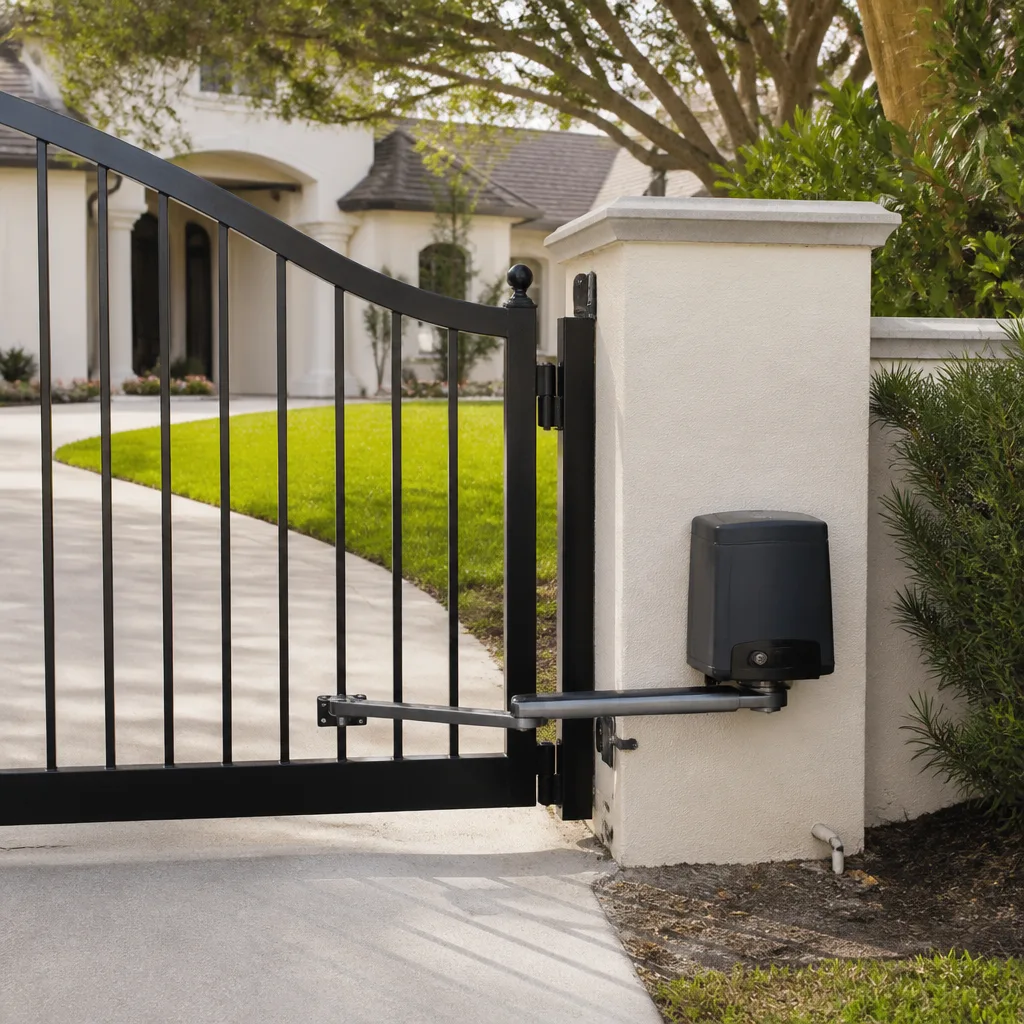 LiftMaster operators
Free on-site gate assessment - hinges, posts, and your LiftMaster or Nice gate operator checked before anything is quoted
The assessment is free and the quote is the invoice.
Get your free estimateDIY vs Professional Gate Repair: The Orange County Homeowner’s Decision Guide
Most gate repair advice starts with “know your limits,” then offers a vague list of tasks you can maybe tackle. This guide does something different. We’re drawing the line at the task level, not the person level, because some gate repairs carry consequences that no YouTube tutorial will mention. A keypad swap is a legitimate Saturday project. Adjusting the limit switches on an automatic operator is a different animal entirely. Get that wrong and you can create a gate that closes on a person and doesn’t reverse, and UL 325 exists specifically because that has happened. This guide covers which specific Orange County gate repairs are reasonable to DIY, which ones require caution, and which ones should only be handled by a professional Gate Repair services, along with the real costs and liability questions most homeowners never think to ask.
Styles & brands we work with
Quick Answer
DIY gate repair in Orange County is reasonable for tasks like replacing a keypad, swapping out a remote, lubricating hinges, or tightening loose hardware. It’s not reasonable for anything touching the automatic operator’s safety systems, load-bearing post welds, or the motor itself. Those repairs carry code requirements, safety standards, and liability exposure that a professional repair carries insurance and a written guarantee against. If the gate moves on its own, the professional line has already been crossed.
Table of Contents
- The Task-Level Breakdown: Green, Yellow, and Red Repairs
- UL 325 Explained: The Safety Standard That Changes Everything
- The True Cost Comparison: DIY vs. Professional, Done Honestly
- The Warranty Trap: DIY Repairs That Void Manufacturer Coverage
- Using a Professional Diagnostic Visit Strategically
- Orange County-Specific Factors: Climate, Code, and Market Realities
- Common Mistakes to Avoid
- When to Call a Professional
- Frequently Asked Questions
- The Bottom Line
The Task-Level Breakdown: Green, Yellow, and Red Repairs
Gate repair isn’t one job. It’s maybe three dozen distinct tasks, and they don’t all belong in the same column. Here’s how we separate them after sixteen years of watching what happens when Orange County homeowners take on the wrong one.
Green: DIY is reasonable
These tasks don’t touch the operator’s wiring, don’t involve load-bearing structure, and don’t carry code implications. If you’re reasonably handy, go ahead.
- Replacing a keypad. Most keypads for Mighty Mule, LiftMaster, and other common Orange County operators are surface-mount and run on their own battery. You’re not touching the main board.
- Swapping a remote control. Programming most remotes takes five minutes and a ladder. This is the single most common DIY gate repair, and for good reason, it works.
- Lubricating hinges, rollers, and the gate track. A can of white lithium grease or a silicone spray keeps most sliding and swing gates from dragging. In coastal Orange County air, regular lubrication also fights salt corrosion. Do this quarterly if you’re within two miles of the ocean.
- Tightening loose bolts and bracket hardware. Gate panels sag over time, especially on the decomposed granite and sandy soil common in Anaheim Hills and Yorba Linda. Snugging bolts back down is routine maintenance.
- Cleaning photo-eye sensors. The sensors that keep an automatic gate from closing on a car or a child get dusty. Wiping them with a dry cloth is fine. Re-aiming them is a different story, which is why that task sits in the yellow column.
Yellow: DIY is possible, but only with specific caution
These tasks are mechanical, not electrical, but they have failure modes that can damage the gate, the operator, or a person if done wrong.
- Realigning photo-eye sensors. If the gate won’t close, the sensors have probably been knocked out of alignment by the gate bumping them or by a gardener’s weed trimmer. Realigning them is usually a matter of loosening a bracket and retightening it. The caution: the alignment must be exact, and you must test that the gate reverses when the beam is broken. If it doesn’t reliably reverse, you’ve left a UL 325 violation in place.
- Replacing a broken hinge on a lightweight pedestrian gate. A walk gate hinge is a bolt-and-wrench job. A driveway gate hinge is a different story entirely, and it’s in the red column.
- Re-tensioning a chain on a chain-drive sliding gate. Slack chains cause premature sprocket wear. But over-tightening a chain puts stress on the operator’s drive shaft and can crack a bearing. The sweet spot matters.
- Replacing a gate wheel or roller on a sliding gate. If the gate is off its track, you can sometimes lift it back onto a new roller with a pry bar and patience. If the gate is heavier than you can safely lift, that’s a red-column job.
Red: Professional required by code, safety standard, or plain physics
These are the tasks where a mistake isn’t a nuisance. It’s a safety event or a code violation.
- Adjusting limit switches on an automatic operator. The limit switches tell the gate where to stop opening and where to stop closing. If the close limit is set even an inch too far, the gate crushes against its stop and either damages itself or, on a sensitive obstruction detection system, reverses slowly enough that a child or pet can be pinned. This task is red because the testing protocol for adjusting it correctly is written into UL 325, and the liability for adjusting it incorrectly is yours, not the manufacturer’s.
- Welding or repairing load-bearing gate posts. In California, a driveway gate post that supports an automatic operator carries the full dynamic load of the gate every single cycle. A bad weld on a hinge post can shear without warning, and a falling driveway gate can kill. This is not hyperbole. Weld repairs on load-bearing posts require proper penetration, appropriate filler metal, and in many Orange County jurisdictions, a permit when the post is part of a fence or gate assembly over a certain height.
- Replacing an actuator or a swing-arm motor. The actuator, the motorized arm that physically pushes the gate open, is the heart of an automatic swing gate. Installation involves setting travel limits, wiring to the control board, and verifying the entrapment protections. If the gate closes on someone because the actuator was installed wrong, the installer’s liability is on you, not on the person who sold you the part.
- Any repair to the control board or internal wiring. Modern operators from LiftMaster, FAAC, and BFT have sealed control boards with integrated surge protection. Opening the housing and probing around isn’t a repair, it’s a parts order waiting to happen.
For a fuller picture of the range of repairs that fall on both sides of this line, our Gate Repair in Orange County page walks through the most common service calls we see.
UL 325 Explained: The Safety Standard That Changes Everything
UL 325 is the safety standard that governs automatic gate operators in the United States. It exists because, starting in the 1980s and 1990s, automatic gates killed people, including children, by closing on them and not reversing. The standard mandates that every automatic gate operator installed or maintained after a certain date must include entrapment protection: a mechanism that detects an obstruction and reverses the gate before it causes injury.
There are two types of entrapment protection that matter for Orange County homeowners. The first is external entrapment protection, usually a pair of photo-eye sensors mounted near the bottom of the gate opening. The second is inherent entrapment protection, which is built into the operator itself and senses resistance on the motor. Most operators installed in Orange County today are required to have both, plus an audible alarm that sounds if a single entrapment-protection device fails.
Here’s the part that matters for the DIY question: any repair that touches the close limit, the reversing mechanism, the photo-eye alignment, or the control board’s obstruction-sensing logic is a UL 325-relevant repair. If that repair is done incorrectly, the gate can close on a person and not reverse, and the person who did the repair bears the liability for it. A homeowner who adjusts their own limit switches, tests the gate a few times, and declares it good has just certified their own work against a safety standard they may not fully understand.
In Orange County, where automatic driveway gates are common in neighborhoods from Newport Coast to Coto de Caza, the practical implication is this: when the gate stops reversing properly after a power outage or a bump, the repair isn’t “just an adjustment.” It’s a safety-system repair. And that’s a professional column job.
The True Cost Comparison: DIY vs. Professional, Done Honestly
Every DIY-versus-pro discussion starts with the parts price. That’s the wrong number. The right number is the total cost of the DIY attempt when it doesn’t work, plus the professional repair that follows, compared to the written-price professional quote upfront.
Here’s a realistic Gate Repair Cost Breakdown: The Orange County Homeowner’s Reference for 2026 for common Orange County gate repairs, based on what we see in the field. These are market ranges, not quotes, but they’ll give you a honest starting point.
| Repair Task | Typical DIY Parts Cost | Typical Professional Cost (Parts + Labor) | Realistic DIY Failure Rate | Cost When DIY Fails and Pro Must Fix It |
|---|---|---|---|---|
| Replace a keypad | $60-$150 | $180-$300 | Low (under 10%) | $180-$300 (pro installs the part you bought) |
| Replace a remote | $35-$80 | $120-$200 including remote | Very low | $120-$200 |
| Replace a swing-gate actuator | $350-$800 for the part | $900-$1,700 parts and labor | High (over 40%) | $900-$1,700, plus the $350-$800 you already spent |
| Adjust limit switches / reversing behavior | $0 (just your time) | $150-$350 | High for correctness; you might make it work without making it safe | $150-$350, but the real risk is liability, not money |
| Weld-repair a load-bearing hinge post | $80-$200 in steel and welding supplies if you already own a welder | $400-$950 depending on access and post condition | Moderate for metal work; high for safe, code-compliant results | Often higher than the original repair, since a failed weld can damage the gate panel too |
| Replace a sliding gate wheel | $25-$60 for the wheel | $200-$400 for wheel, hardware, and track check | Moderate; the gate may need track adjustment too | $200-$400 |
The pattern is consistent. The DIY-friendly tasks are the cheap ones where failure means you buy a slightly nicer part and try again. The professional-only tasks are the expensive ones where failure means you’ve spent hundreds of dollars and still need the pro, and in some cases, the pro now has to undo a mistake before fixing the original problem.
Every professional repair from Portcullis Gate Repair Orange County home includes a written price before the work begins, so you’re comparing your true all-in DIY cost against a known number, not a mystery invoice.
The Warranty Trap: DIY Repairs That Void Manufacturer Coverage
Most gate-operator manufacturers, including LiftMaster, FAAC, and BFT, write their warranties in language that requires installation and service by a qualified technician. A homeowner who opens the control board housing and starts probing around has, in the manufacturer’s view, compromised the product, and most warranty claims that follow will be denied on those grounds.
Here are the specific DIY repairs we see in Orange County that end up voiding an otherwise good manufacturer warranty:
- Replacing a control board after buying the part online. The boards for LiftMaster and FAAC operators are specific to the model and revision. Getting the wrong board, or installing the right board and missing a setting, is common. Then the operator is down and the manufacturer has no record of a certified install.
- Rewiring a photo-eye sensor pair. Photo-eyes run on low voltage, but they tie into the operator’s logic board in a specific polarity. Reversing the wiring doesn’t just stop the gate, it can short the board. The warranty on the board is now gone.
- Fitting a non-OEM actuator to a branded operator. A universal swing-arm actuator is cheaper than the OEM part for a FAAC or BFT system, but the control board may not communicate with it properly. The board eventually fails, and the manufacturer’s answer is that an unapproved component was used.
- Adjusting limit switches repeatedly while troubleshooting. Each adjustment puts stress on the mechanical stop and the drive train, and the repeated adjustments often mask an underlying gear problem. When the gearbox finally fails, the manufacturer sees signs of non-standard service and denies the transmission warranty.
The practical takeaway isn’t “never touch your gate.” It’s “never touch your gate in a way that risks the manufacturer’s warranty on the expensive parts.” A keypad or remote swap doesn’t do that. Opening the operator housing does.
Using a Professional Diagnostic Visit Strategically
Here’s a move most Orange County homeowners don’t know is available to them: hire a professional for a diagnostic visit, get the written parts list and the quote, and then decide which tasks to hand off and which to do yourself.
The diagnostic visit usually costs $75-$150, and at our shop it includes a written diagnosis of what’s actually wrong, a written quote for the repair, and a written parts list if you ask for one. That parts list is the strategic asset. It tells you the exact actuator model, the exact board revision, the exact bracket kit, and whether the repair is a bolt-on part swap or something requiring programming and testing.
Here’s the step-by-step way to use this visit:
- Call us at (820) 529-0801 and ask for a diagnostic visit. You’ll get a real arrival window, and the technician will arrive in uniform, background-checked.
- Get the written diagnosis and quote. Everything is in writing before any work starts, as it always is on a Kingswell job.
- Ask for the parts list. The technician will tell you which parts are needed, what they cost, and whether the labor is straightforward or requires programming and testing.
- Decide which tasks you’ll take on. If the diagnosis says the keypad needs replacing and the actuator needs a professional, you can do the keypad yourself and have us handle the actuator.
- Schedule the professional portion with a written price. You’re not paying for the parts you already replaced, and you’ll have the labor portion of the quote in writing.
This approach respects the DIY instinct without gambling your safety or your operator’s warranty on it. And it’s a lot cheaper than the alternative, which is buying the wrong part online, installing it, and then paying for the professional repair after the original problem has been compounded.
Orange County-Specific Factors: Climate, Code, and Market Realities
Orange County isn’t one climate. It’s three, and each one affects gate repair differently.
Coastal Orange County (Newport Beach, Huntington Beach, Laguna Beach, Dana Point) deals with salt air and marine layer moisture. Steel hardware corrodes faster here than anywhere else in the county. Gate hinges, bracket bolts, and exposed operator housings need more frequent replacement, and the electrical connections inside the operator housing suffer from corrosion that inland homeowners never see. We regularly open coastal operators to find green, crusty terminals that were fine a year earlier.
Inland Orange County (Anaheim, Orange, Fullerton, Santa Ana) sees extreme summer heat, and that heat kills gate-operator control boards. The boards sit inside a metal housing that bakes in 100-degree sun, and the capacitors degrade faster than the manufacturer’s expected lifespan. Homeowners in inland OC will replace control boards more often than coastal homeowners, and the failure often shows up as a gate that works intermittently on hot afternoons.
Hillside and canyon Orange County (Anaheim Hills, Yorba Linda, Coto de Caza, Trabuco Canyon) deals with soil movement and sloped installations. Gate posts shift on hillsides, hinges bind, and swing gates go out of alignment as the ground moves through wet winters and dry summers. Canyon areas also deal with more wildlife, which means the photo-eye sensors get knocked out of alignment more often by coyotes and deer pushing through the gate opening.
These local conditions matter for the DIY-versus-pro decision because they change the failure profiles. A coastal homeowner lubricating hinges every quarter might keep hardware alive for years, while an inland homeowner with a cooked control board has no DIY option at all, the board replacement requires programming.
Orange County also has specific permitting considerations. Many cities in the county require a permit for new automatic gate installations and for some structural repairs to fence and gate assemblies over a certain height. A professional gate company knows which cities require what, and that knowledge is part of what you’re paying for when you hire someone local rather than ordering parts online.
If you’re weighing a repair against a full replacement, our Gate Installation in Orange County page covers what a new automatic gate project actually involves.
Common Mistakes to Avoid
- Buying parts on Amazon before the gate is diagnosed. We see this at least twice a month in Orange County. A homeowner buys a $400 actuator online, installs it, and the gate still doesn’t work because the problem was the control board or a limit switch, not the actuator. The $400 part becomes a shelf ornament.
- Assuming “the gate won’t close” is a sensor problem. In coastal Orange County, it’s often corrosion on the control board terminals. In inland Orange County, it’s often a heat-fatigued board. Swapping the photo-eyes doesn’t fix either one.
- Oiling a gate track with WD-40. WD-40 is a solvent, not a lubricant. It washes away existing lubrication and attracts dust. On the dirt-and-dust tracks common in Orange County’s dry inland areas, that’s a recipe for a gate that drags worse than before.
- Welding a post without checking the gate’s alignment first. If the gate has been dragging or sagging, the post may have moved because the soil underneath it shifted. Welding the hinge back on without addressing the movement means the repair will fail again, often within a year.
- Not testing the auto-reverse after any DIY adjustment. If you adjust anything on an automatic gate, the final step is testing that the gate reverses when it encounters resistance. Skipping this step leaves a UL 325 violation in place and a gate that can close on a person.
- Ignoring the gate’s weight when attempting a DIY lift. Driveway gates in Orange County often weigh 300 to 600 pounds. A homeowner with a pry bar and good intentions can lift one side, but if it slips, serious injury is a real possibility. If you can’t lift it confidently with a helper, it’s a professional-column job.
When to Call a Professional
Call a professional when the gate moves on its own and the repair touches the motor, the limit switches, the reversing mechanism, the photo-eye logic, or the control board. Call a professional when a load-bearing post or hinge weld needs repair. Call a professional when you’ve already made a DIY attempt and the gate still isn’t working right. And call a professional when the manufacturer’s warranty matters to you, because DIY interior work voids it.
Portcullis Gate Repair Orange County offers free estimates in Orange County. Every job includes a written price before any work starts, a written Kingswell Guarantee on the repair, and a 365-day Done Right Promise that means if the repair fails within a year, we come back and fix it at no charge. Call (820) 529-0801 and a live person will answer, twenty-four hours a day, seven days a week.
Frequently Asked Questions
Replacing a keypad, swapping a remote, lubricating hinges and rollers, tightening loose hardware, and cleaning photo-eye lenses are all reasonable DIY tasks in Orange County. None of these tasks touch the operator’s wiring, the entrapment protections, or the load-bearing structure of the gate. If the repair requires opening the operator housing or touching the control board, that’s a professional-column job. For a full run-down on what can be repaired versus replaced, see our Electric Gate Repair in Orange County page.
Most professional gate repairs in Orange County run $150 to $950 depending on the task. A keypad replacement typically costs $180-$300, a limit-switch adjustment $150-$350, a swing-gate actuator replacement $900-$1,700 parts and labor, and a load-bearing weld repair $400-$950. Every Portcullis job includes a written price before the work starts, so you’ll know your exact number before a single bolt is turned. Call (820) 529-0801 for a free estimate.
Yes. Most gate-operator manufacturers, including LiftMaster, FAAC, and BFT, write their warranties to require installation and service by a qualified technician. Opening the operator housing, rewiring sensors, installing non-OEM parts, or repeatedly adjusting limit switches can all void the warranty on the expensive components. The safest DIY tasks are the external ones: keypads, remotes, lubrication, and hardware tightening.
UL 325 is the safety standard that governs automatic gate operators, and it mandates entrapment protection so a gate reverses when it encounters an obstruction instead of crushing it. Any repair that touches the close limit, the reversing mechanism, the photo-eye alignment, or the obstruction-sensing logic is a UL 325-relevant repair. If that repair is done incorrectly, the gate can close on a person and not reverse, and the person who did the repair carries the liability.
Yes. Coastal Orange County neighborhoods from Newport Beach to Dana Point deal with salt air and marine layer moisture that corrode gate hardware faster than inland areas. Steel hinges, bracket bolts, and exposed operator terminals rust and corrode. Owners within two miles of the ocean should lubricate hardware quarterly and expect more frequent replacement of exterior hardware than inland homeowners.
Yes. Portcullis Gate Repair Orange County offers a diagnostic visit that includes a written diagnosis, a written quote, and a written parts list. You can use that list to handle the simple tasks yourself, like replacing a keypad, while we handle the safety-critical repairs like actuator replacement or limit-switch adjustment. The goal is an informed decision, not an all-or-nothing repair bill.
The Bottom Line
DIY gate repair isn’t about how handy you are. It’s about which tasks carry consequences if they’re done wrong. In Orange County, a keypad swap is a reasonable Saturday project. Adjusting the limit switches on an automatic operator is a safety-system repair governed by UL 325, and a weld on a load-bearing post is a structural repair with code implications. The honest cost comparison always favors DIY for the cheap, external tasks and professional service for the expensive, safety-critical ones. For more guides & resources, explore our blog. When the gate moves on its own, the line has been crossed. Get a written price before any work starts, and know what the repair actually involves before you decide who does it.
Written by Dean Prescott, Owner at Portcullis Gate Repair Orange County, serving Orange County since 2008.
See the difference
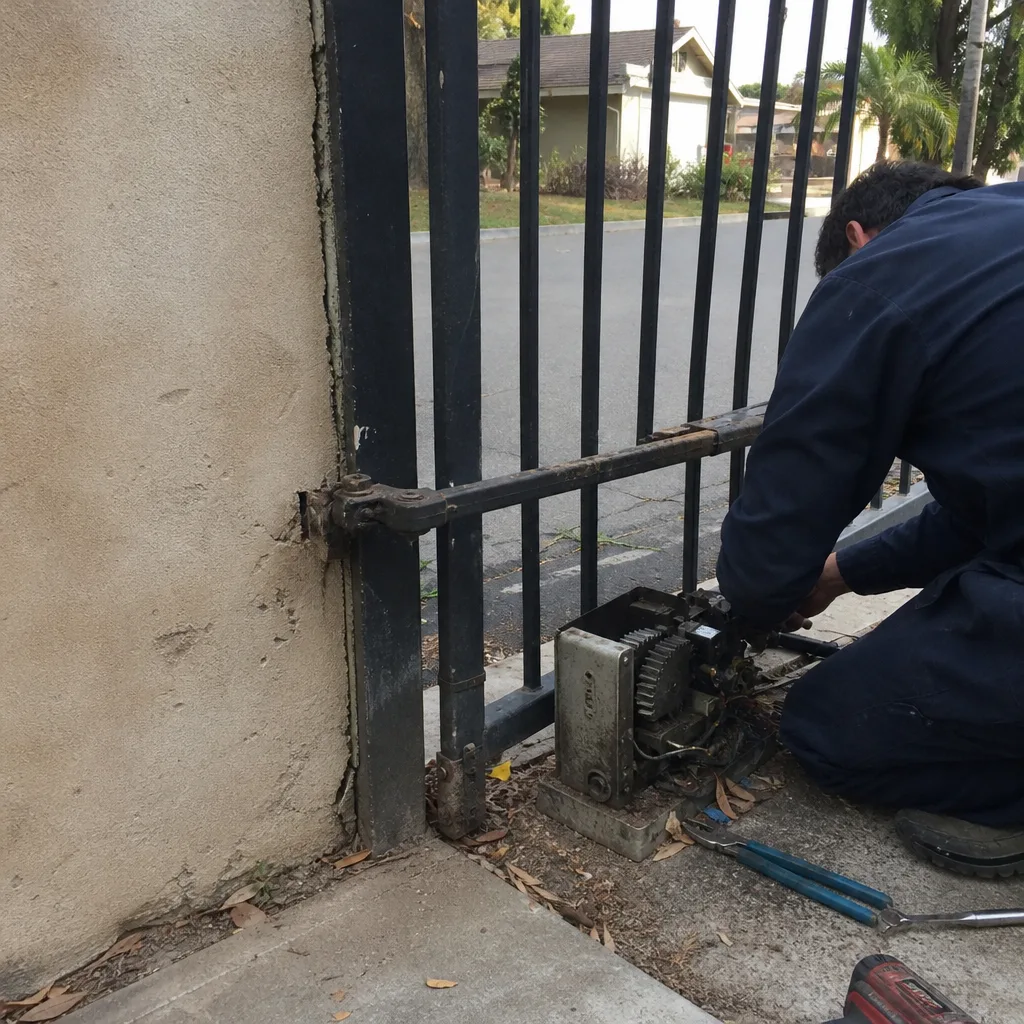 Before
 After
 Before
 After
 Before
 After