
Last updated October 16, 2026
 Wood & steel frame
 Farm & ranch
 LiftMaster operators
Free on-site gate assessment - hinges, posts, and your LiftMaster or Nice gate operator checked before anything is quoted
The assessment is free and the quote is the invoice.
Get your free estimateGate Repair Warning Signs: A Orange County Homeowner’s Reference Guide
A gate that hesitates for half a second before closing isn’t “getting old” – it’s a limit switch telling you it’s about to fail and take the control board with it if you wait long enough. Most Orange County homeowners don’t have a gate emergency; they have a gate whisper. This guide teaches you to hear it. We’ll pair each warning sign with the exact component it predicts, explain what a repair actually costs in this market, and show you how to describe the problem so you get an accurate written price before anyone shows up. Because the difference between a $180 limit-switch swap and a $600 control-board replacement is usually about six weeks of ignoring a half-second hesitation.
Styles & brands we work with
Quick Answer
The warning signs that matter most in Orange County are: a gate that hesitates before closing (limit switch failure), a grinding noise during travel (roller or track debris, sometimes gearbox wear), slow operation in one direction only (capacitor or battery, depending on your operator), intermittent “dead” gate (control board or loop detector), and rust bubbling under the paint on coastal steel gates (structural corrosion). Each of these signals points to a specific, fixable component. Caught early, most repairs run $150 – $400 parts and labor; ignored, they cascade into $600 – $1,800 failures that take out attached systems.
Table of Contents
- A Symptom-to-Component Index for Orange County Gates
- The Sounds That Tell You What’s Failing
- Speed Changes and What They Mean
- Intermittent Failures: The Most Expensive Warning Sign to Ignore
- Safety Warning Signs You Cannot Defer
- The OC-Specific Problem: Rust Bubbling Under Paint on Coastal Steel Gates
- How to Describe a Warning Sign Over the Phone for an Accurate Written Estimate
- Common Mistakes to Avoid
- When to Call a Professional
- Frequently Asked Questions
- The Bottom Line
A Symptom-to-Component Index for Orange County Gates
Most gate problems are blamed on “the motor” or “the gate being old.” In our experience across Orange County, the actual culprit is usually a $20 – $80 part that was signaling its failure for weeks before the gate stopped. Here is the index we use when a homeowner calls and describes a symptom. Each line pairs the behavior with the part it predicts, and the typical parts-and-labor range for this market.
- Gate hesitates before closing, then closes normally: Limit switch. $150 – $280.
- Grinding or crunching during travel: Roller bearings or track debris. If the noise is only under load, gearbox wear. $120 – $350.
- Slow open but normal close (swing gate): Capacitor on the operator. $180 – $320.
- Slow open but normal close (slide gate): Failing battery in a solar-powered system. $200 – $450 depending on battery type.
- Slow in both directions: Motor windings degrading, or the gate physically binding. $350 – $900.
- Gate stops mid-travel and reverses, with no obstruction: Obstruction sensor adjustment, or a failing safety edge. $120 – $250.
- Gate is dead at the keypad, but the breaker is on: Control board, or a tripped GFCI outlet. $40 – $650 depending on which.
- Gate opens on its own, with no command and no car present: Loop detector failure. $180 – $400.
This index is the backbone of every diagnosis our technicians do on Gate Repair in Orange County. The point is that you don’t need to know the trade terminology to identify the probable part – you need to describe the behavior accurately. The part name is our job. Your job is the observation, and the earlier you make it, the cheaper the fix.
The Sounds That Tell You What’s Failing
Sound is the most reliable early-warning system a gate has. It’s also the most ignored, because a gate that still opens and closes “just makes noise, right?” Not exactly. Here’s how we distinguish the three common failure sounds, using what a technician actually listens for on a service call.
The Grinding/Crunching Sound
What it usually means: Metal-on-metal wear in the roller bearings or debris packed into the track. If your gate is on a steel track – common in newer Orange County developments like Orange County Great Park or Rancho Mission Viejo – the track collects sand, decomposed granite from landscaping, and palm debris. That grit acts like sandpaper on the rollers. The fix is usually cleaning and roller replacement, not a new motor.
When it’s more serious: If the grinding is present only when the gate moves under load (pushing a heavier leaf, or going uphill), the gearbox inside the operator may be stripping. That’s a $500 – $900 repair on most operators, including LiftMaster and FAAC models we service regularly.
The Hum That Changed Pitch
A swing-gate operator has a capacitor that gives the motor its first push. When that capacitor weakens, the motor hums at a lower pitch and the gate starts slow. This is one of the cheapest parts to replace and one of the most misdiagnosed. Homeowners assume “the motor is dying.” In our experience, it’s the capacitor in roughly 70% of slow-start swing-gate calls in Orange County.
The Click That Does Nothing
A click from the operator when you press the remote, but no movement, is almost always an electrical supply issue – a tripped circuit, a GFCI that popped during rain, or a corroded connection in the operator housing. On coastal properties from San Clemente to Huntington Beach, salt air accelerates connection corrosion. The click is the relay trying to fire. If it’s a bad connection, the repair is under $100. If the board itself is dead, it’s $300 – $650.
Sound matters because it lets a technician pre-diagnose over the phone. When you call us and say “it grinds in both directions,” we already know we’re bringing rollers and track tools. When you say “it hums low and starts slow in the morning,” we’re bringing a capacitor. That’s how you get a real written price before the truck rolls.
Speed Changes and What They Mean
“It’s been getting slower for a while” is the most common phrase we hear in Orange County when a gate finally dies. By the time the gate stops completely, the part that caused the slowdown has often taken something else with it. The direction of the slowdown – one way vs. both ways – is the key diagnostic detail, and it’s one most homeowners never think to mention.
Slow in One Direction Only
Swing gate, slow opening, normal closing: The capacitor is weak. This is a $180 – $320 fix on most models. Ignore it, and the motor eventually won’t start at all – at which point the technician replaces the capacitor anyway, but now the motor has been strained for months. On a Mighty Mule or Ghost Controls operator, the strain can also damage the arm’s internal limit mechanism.
Slide gate, slow opening, normal closing: If you have a solar-charged battery system, the battery is failing. Orange County’s inland heat – think Yorba Linda, Orange, Villa Park, where summer temperatures consistently hit the 90s – shortens battery life significantly. A battery that’s three years old in that heat is on borrowed time. Replacements run $200 – $450 installed depending on the battery type and whether you need a new charge controller.
Slow in Both Directions
Motor degradation or physical binding. This is the expensive one, because it can be either, and they present identically to a homeowner. The way we narrow it down: if the gate is slow in both directions but the motor sounds normal, the gate itself is binding – a failing roller, a bent track, a hinge that’s seized. That’s a mechanical repair, usually $350 – $900 depending on what’s bent or seized. If the motor sounds labored in both directions, the windings are degrading and the operator needs rebuilding or replacing, $600 – $1,800 depending on the brand and model.
The cost difference between “slow in one direction” and “slow in both directions” is a factor of three or more. That’s why we ask that exact question on the phone. Speed changes are not “the gate being old.” They are a component giving you a countdown.
Intermittent Failures: The Most Expensive Warning Sign to Ignore
An intermittent gate is the one that works every time you try to show a neighbor, and fails every time you’re late to work. It’s also the failure type that generates the most at-the-door quote revisions in this trade, because intermittent problems are genuinely harder to diagnose. A company that quotes you over the phone without asking about the pattern of the intermittency is guessing. Here’s what the pattern actually tells us.
The Gate That’s Dead Intermittently at the Keypad
If the keypad works sometimes and not others, and the remote works fine during the dead spells, the problem is the keypad itself or its wiring – not the operator. Keypad replacement runs $150 – $300. If both the keypad and remote go dead at the same time, the control board is losing power or failing. That’s a $300 – $650 repair on most operators, including the Elite and DoorKing models we service.
The Gate That Opens Intermittently for No Apparent Reason
A gate that opens on its own, or opens when no car is present, is almost always a loop detector issue. The loop is a wire buried in the driveway that detects the metal mass of a vehicle. When it fails, it can send phantom trigger signals. This is a safety issue – a gate opening unexpectedly can hit a car, a pedestrian, or a child on a bike. The repair is a new loop detector or a new saw-cut loop, $180 – $400. This is not a sign to live with for a month while you decide.
The Gate That Works After It Rains, Then Dies When It’s Dry
This pattern sounds counterintuitive, but it happens in Orange County more than you’d think. Moisture can temporarily improve a corroded electrical connection by swelling the contact point. When it dries out, the connection gap opens and the gate stops. If your gate works right after rain and quits during a dry spell, you have corrosion in the operator housing or the junction box. That’s a $100 – $250 electrical repair, but only if it’s caught before the corrosion spreads to the board.
Our advice on intermittent failures is simple: track the pattern for three days, write down what was happening each time it failed, and then call. Pattern data cuts diagnosis time dramatically, and it’s what lets us give you a written price range that won’t change when the tech arrives.
Safety Warning Signs You Cannot Defer
Some gate problems are inconveniences. A slow gate is an annoyance. A noisy gate is an irritation. But three specific warning signs are safety defects, and the only correct response is to call a gate repair company immediately and stop using the gate until it’s fixed. These are the ones where a cheap part has failed in a way that removes a protective function.
1. A Gate That Reverses Inconsistently
Every automatic gate in Orange County is required to have an obstruction-reversal system – either a safety edge (a pressure-sensitive strip on the leading edge of the gate) or an internal current-sensing system, or both. When that system works correctly, the gate reverses when it encounters resistance: a child, a dog, a car bumper. When it reverses inconsistently – sometimes bouncing back at the lightest touch, sometimes pushing through resistance – the safety system is failing. This is a stop-using-the-gate-today situation. The repair is typically $120 – $250 for a new safety edge or a sensitivity adjustment, but the cost of ignoring it is measured in a different currency entirely.
2. A Gate That Moves Without a Command Signal
We covered phantom triggering above as an intermittent issue, but any unexpected movement is a safety defect until proven otherwise. A gate that starts its cycle when nobody pressed a button, when no car is present, and when no wind is pushing the leaf, has a malfunctioning trigger circuit. A gate that moves without a command can close on a vehicle or a person. The repair is usually a loop detector or a control board input issue. Until it’s diagnosed, the gate should be put in manual mode or the power should be shut off at the breaker.
3. A Gate with a Sagging Bottom Edge
On a swing gate, a sagging bottom edge – the gate droops toward the latch side and the bottom corner scrapes or sits closer to the ground than it used to – means a hinge is failing or the gate frame itself has compromised. On a heavy steel gate, a sagging leaf puts enormous strain on the operator, but the bigger risk is the hinge giving way entirely. A falling gate leaf can injure anyone in its arc. Hinge replacement on most residential gates runs $350 – $800, and it’s a repair we do frequently in older Orange County communities where original gates from the 1980s and 1990s are reaching the end of their hinge life.
These three signs are the ones where we tell homeowners the same thing every time: this is not a quote-and-wait situation. This is a turn-the-power-off-and-call situation. The safety systems on an automatic gate exist because a moving gate has enough force to cause serious injury, and when those systems fail, the gate is not a convenience defect. It’s a hazard.
The OC-Specific Problem: Rust Bubbling Under Paint on Coastal Steel Gates
If your home is within a few miles of the coast – San Clemente, Dana Point, Laguna Beach, Corona del Mar, Newport Beach, Huntington Beach – your steel gate is aging faster than an identical gate in Irvine or Anaheim Hills. Salt air is the accelerant. The warning sign is distinctive and easy to spot if you know what you’re looking for: small bubbles or blisters in the paint, usually starting at the bottom rail, the hinge plates, or along the weld seams. It looks like a paint defect. It isn’t.
What’s Actually Happening
Steel rusts. Paint seals the steel. When salt air sits on the metal – even a little bit, even through a scratch or a thin spot in the coating – rust forms under the paint film. The paint hasn’t peeled yet because the rust hasn’t broken through. It’s working underneath, spreading along the metal surface like a slow bruise. By the time the paint bubbles, the corrosion has been active for months. By the time the paint flakes off and you see orange, the steel is losing thickness.
Why It Costs Major If Ignored
Here’s the Orange County math. A gate with early-stage rust bubbling on a bottom rail can be sanded, treated with a rust converter, primed, and repainted. That’s a $300 – $600 repair, and it extends the gate’s life by years. The same gate, left for another 18 to 24 months, has rust that’s eaten through the rail walls. The repair is no longer a refinish – it’s a cut-and-weld structural repair, or a full gate replacement. That’s $1,500 – $4,000 depending on the gate size and style. The warning sign itself – the bubble – looks too small to matter. That’s why it’s the most expensive “minor” thing we see on coastal Orange County gates.
If your coastal gate has rust bubbling, don’t wait for the flake. Call for an assessment while it’s still a paint-and-metal treatment issue. This is one of the most common recommendations we make on Gate Installation in Orange County surveys, where we see gates in every stage of coastal corrosion.
Quick rule of thumb for coastal homeowners: inspect your gate in March, just as the rainy season ends and the salt film has sat on the metal all winter. Look along the bottom 6 inches of the gate first. That’s where the moisture collects, where sprinkler overspray hits, and where the metal stays damp longest. Bubbles there are the earliest sign.
How to Describe a Warning Sign Over the Phone for an Accurate Written Estimate
The single biggest driver of at-the-door price revisions in the gate repair trade is incomplete information at the time of the estimate. When a homeowner says “my gate doesn’t work” and the company quotes a number, that number is a guess. When the tech arrives and finds a seized gearbox instead of a bad remote, the price changes. Here’s How to Hire a Gate Repair Contractor in Orange County: A Step-by-Step Guide on describing a gate problem so you get a real written range before anyone shows up.
- State the exact symptom in one sentence. “The gate opens fine but hesitates before it starts closing.” This is worth more than a five-minute backstory.
- Identify the direction of the problem. Does it happen opening, closing, or both? This is the single most diagnostic piece of information in gate repair, and it’s the one most homeowners leave out.
- Describe the sound, if there is one. Grinding, squealing, humming, clicking, or silent. Use those exact words. Each maps to a different component.
- Note the pattern. Does it happen every time, or intermittently? If intermittent, what was happening when it failed – rain, heat, a specific time of day, after a power outage?
- Mention the operator brand and approximate age, if you know them. The brand is usually printed on the control box or the arm. The age is usually the age of the house, if the gate is original. This lets us know which parts we’re likely bringing.
- Ask for a written price range before the visit. Any reputable company will give you a parts-and-labor range based on your description, and commit to updating the written price before any work starts after diagnosis. If a company won’t quote a range over the phone, that’s not caution – that’s a business model built on revised numbers at the door.
The Kingswell Guarantee on every job we do in Orange County includes a written price before any work begins. That’s not a marketing promise; it’s the only ethical way to run a repair business. When you call Portcullis Gate Repair Orange County home at (820) 529-0801, the person who answers will ask you the six questions above, give you a real price range based on your answers, and send a technician who already knows what he’s walking into. The number doesn’t change at the door unless the diagnosis reveals something genuinely different – and if it does, you get the new number in writing before a single bolt is turned.
Common Mistakes to Avoid
- Waiting until the gate stops completely to call. A gate that exhibits any of the warning signs above is already failing. The half-second hesitation that becomes a dead gate is a $150 repair that became a $600 repair because it took the control board with it. Every warning sign is cheaper to fix before the cascade.
- Lubricating the track with WD-40. WD-40 is a solvent, not a track lubricant. It temporarily quiets a noisy gate and then leaves the metal drier than before. For tracks, use a silicone-based or lithium-based lubricant. For rollers, replacement is usually the real fix.
- Adjusting the force settings on the operator to “fix” a slow or jerky gate. The force dial on an operator is a safety adjustment, not a performance one. Cranking it up to force a binding gate through its travel defeats the obstruction-reversal protection and burns out the motor faster. If the gate binds, fix the binding.
- Assuming a “dead” gate means a new motor. The operator (motor and control board) is the last thing to fail in most cases. The power supply, the limit switch, the remote receiver, or a simple tripped GFCI comes first. A good diagnosis starts at the breaker and works in, not at the motor and works out.
- Ignoring rust bubbles on a coastal gate. The window between “cosmetic paint bubble” and “structural steel replacement” is shorter than most homeowners think, and the repair cost difference is an order of magnitude. In Orange County’s coastal belt, this is the most expensive small thing to ignore.
- Not testing the safety reversal function. Put a piece of cardboard or a trash can in the gate’s path and close it. The gate should reverse before putting any real pressure on the object. Homeowners almost never test this, and it’s the one test that tells you whether your gate is safe for your family. Test it monthly.
- Calling a company that won’t give a written range over the phone. In our trade, the companies with the vaguest phone quotes are the ones with the biggest surprise numbers on the invoice. A real repair company can give you a written price range from a good symptom description. If they can’t or won’t, keep dialing.
When to Call a Professional
Call a gate repair professional the moment you notice any of the safety warning signs above: inconsistent reversing, phantom movement, or a sagging leaf. Call when the gate hesitates, changes speed, or makes a new sound – the earlier the call, the smaller the invoice. And call when you’ve already tried the obvious: checked the breaker, checked the GFCI, replaced the remote battery. We’re Portcullis Gate Repair, an independently owned Kingswell company serving Orange County since 2008. Every call is answered by a live person, 24/7, and every job starts with a written price – no exceptions. Reach us at (820) 529-0801 for a free estimate, or to talk through a symptom over the phone and get a real price range before we even send a truck. For electric gate issues specifically, our Electric Gate Repair in Orange County page covers operator diagnosis in detail.
Frequently Asked Questions
Most gate repairs in Orange County run $150 – $450 parts and labor for common component failures: limit switches, capacitors, safety edges, rollers, and loop detectors. Operator replacement or major structural repairs run $600 – $1,800. The cost depends on the specific component, the operator brand, and whether the failure was caught early or allowed to cascade into attached systems. Call (820) 529-0801 with a symptom description and get a written price range before anyone comes out.
Yes. We keep common components – limit switches, capacitors, safety edges, rollers, loop detectors, and control boards for major brands including LiftMaster, FAAC, Elite, and Mighty Mule – on our trucks, and we answer calls with a live person around the clock. A typical repair with an accurate symptom description is a 45 – 90 minute job once we’re on site. Call (820) 529-0801 to describe what your gate is doing and schedule a visit.
The most common warning signs we see across Orange County are a gate that hesitates before closing, a grinding noise during travel, slow operation in one direction, intermittent dead spells at the keypad, and rust bubbling under the paint on coastal steel gates. Each of these predicts a specific component: limit switch, roller or track debris, capacitor or battery, control board, and structural corrosion, respectively.
Not always – a gate that’s always made the same consistent sound may just have a particular motor, or lack of sound damping. But any change in the sound – a new grind, a new squeal, a low hum where there used to be a higher one – is a specific component talking to you. New sounds are warnings. Old, consistent ones are just character. When in doubt, describe the sound over the phone and we’ll tell you whether it’s one of the patterns we know.
We service nine major gate-operator brands: LiftMaster, FAAC, BFT, Linear, Viking, Ghost Controls, DoorKing, Elite, and Mighty Mule. The technician who arrives at your Orange County property already knows the specific system on the gate, because you told us the brand when you called. That’s what allows us to give a real written price before work starts on operator repairs.
Yes. Every estimate is free, and every job – repair, install, or diagnostic – includes a written price before any work begins. That’s part of the Kingswell Guarantee: written price, real arrival window, clean job site, and written guarantee on the repair. If the repair fails within the 365-day guarantee period, we come back and fix it at no charge. Call (820) 529-0801 to schedule an estimate.
The Bottom Line
The gate that’s about to cost you $1,000 doesn’t announce itself with a bang. It hesitates for half a second. It makes a new sound. It starts a little slow on a Tuesday morning. It has a bump in the paint near the bottom rail. These are the warning signs that matter, and each one points to a specific, fixable component – if you catch it early. Orange County’s coastal salt air, inland heat, and sandy track conditions accelerate certain failures, which makes regular observation the cheapest gate maintenance there is. And when a warning sign shows up, Gate Repair experts say to describe it accurately over the phone. That’s how you get a real written price, a technician who knows what he’s walking into, and a repair that’s guaranteed for 365 days – the Kingswell Way, on every job we do.
Written by Dean Prescott, Owner at Portcullis Gate Repair Orange County, serving Orange County since 2008.
See the difference
 Before
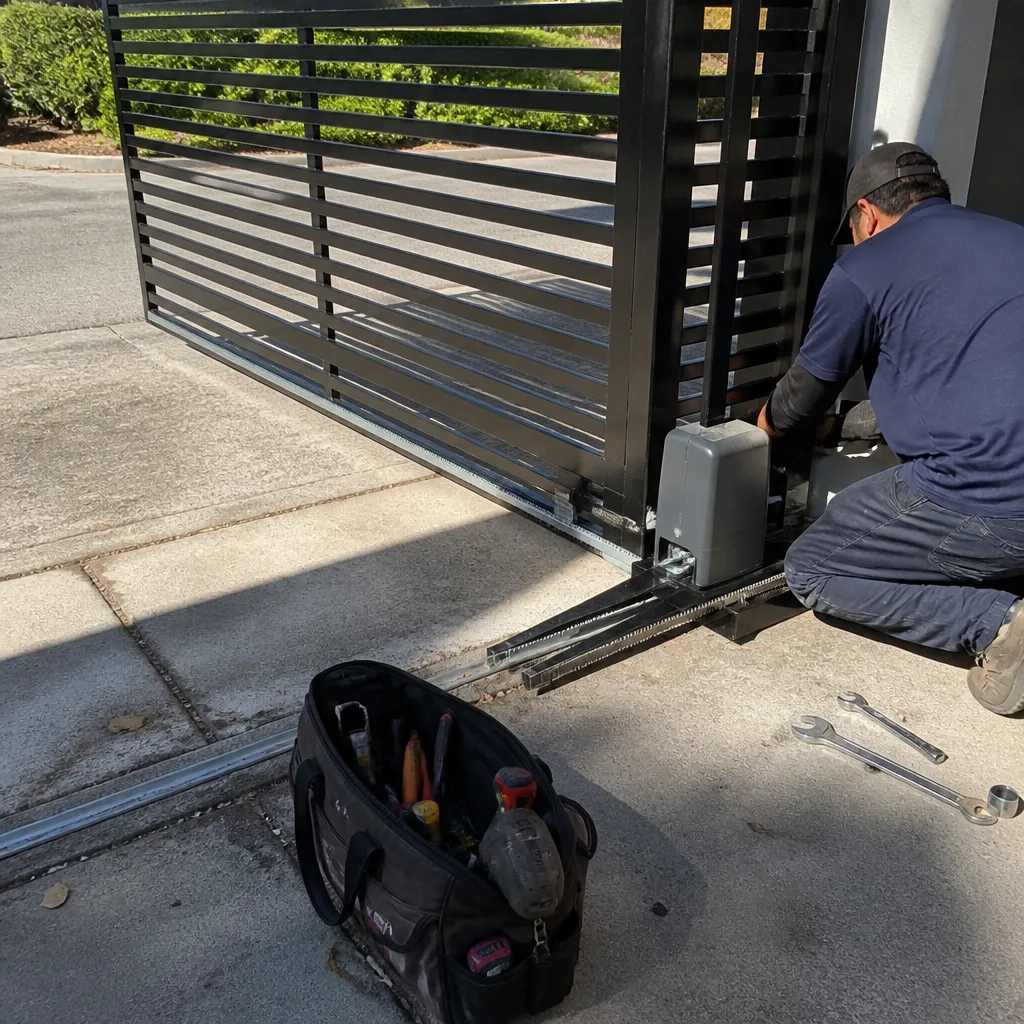 After
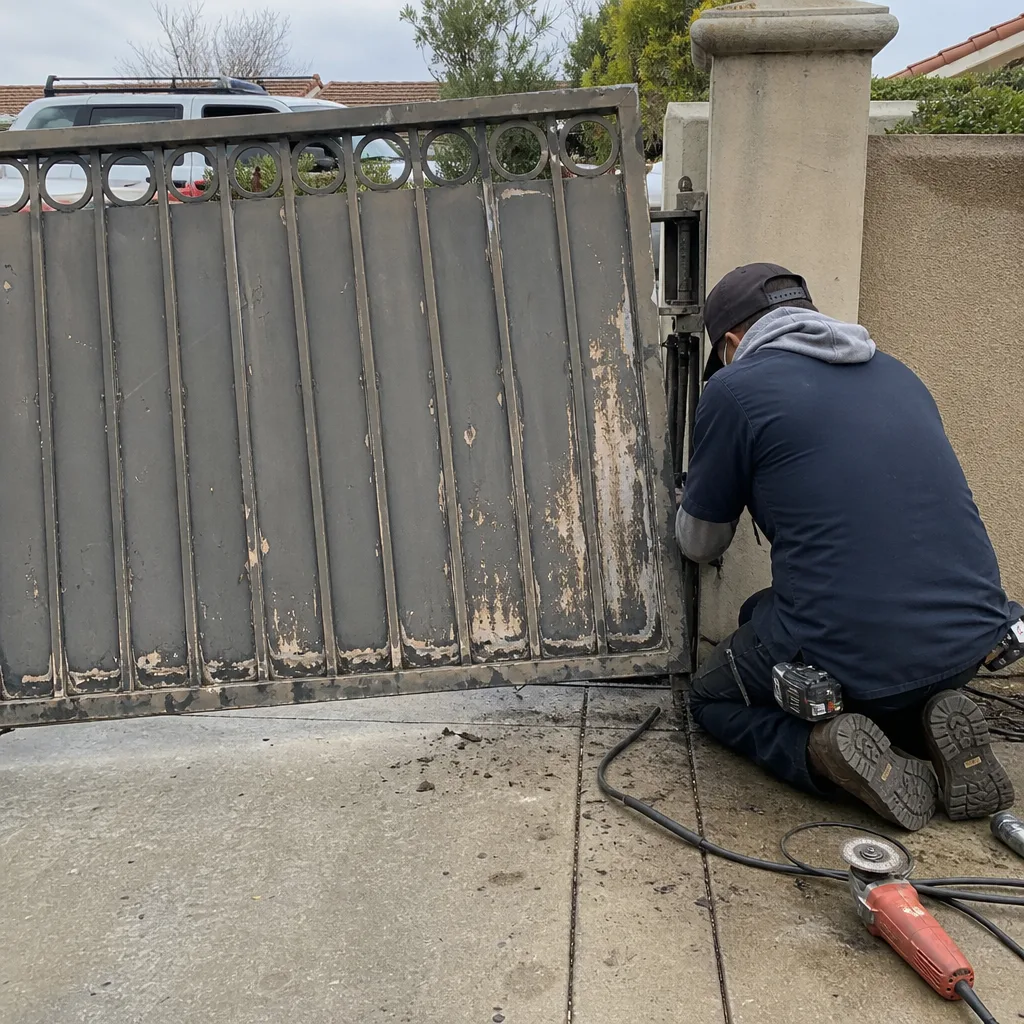 Before
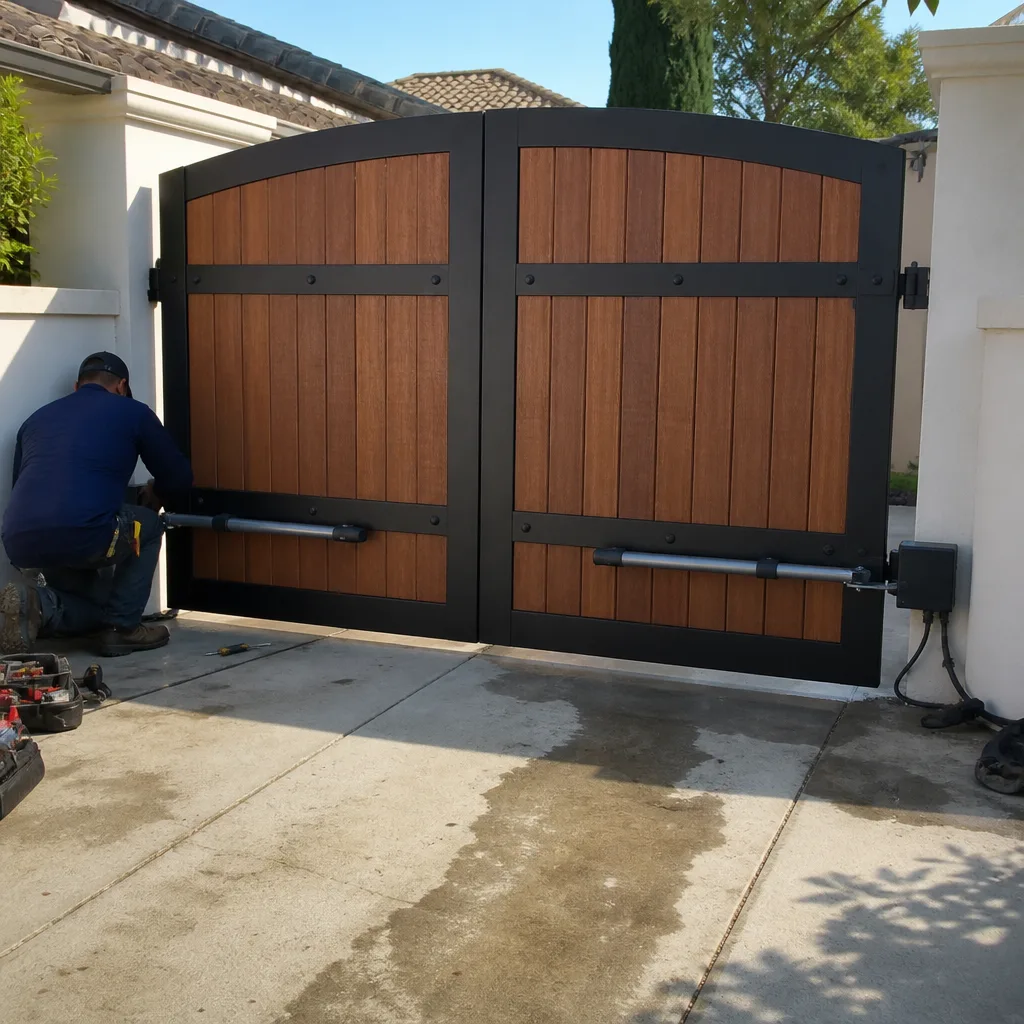 After
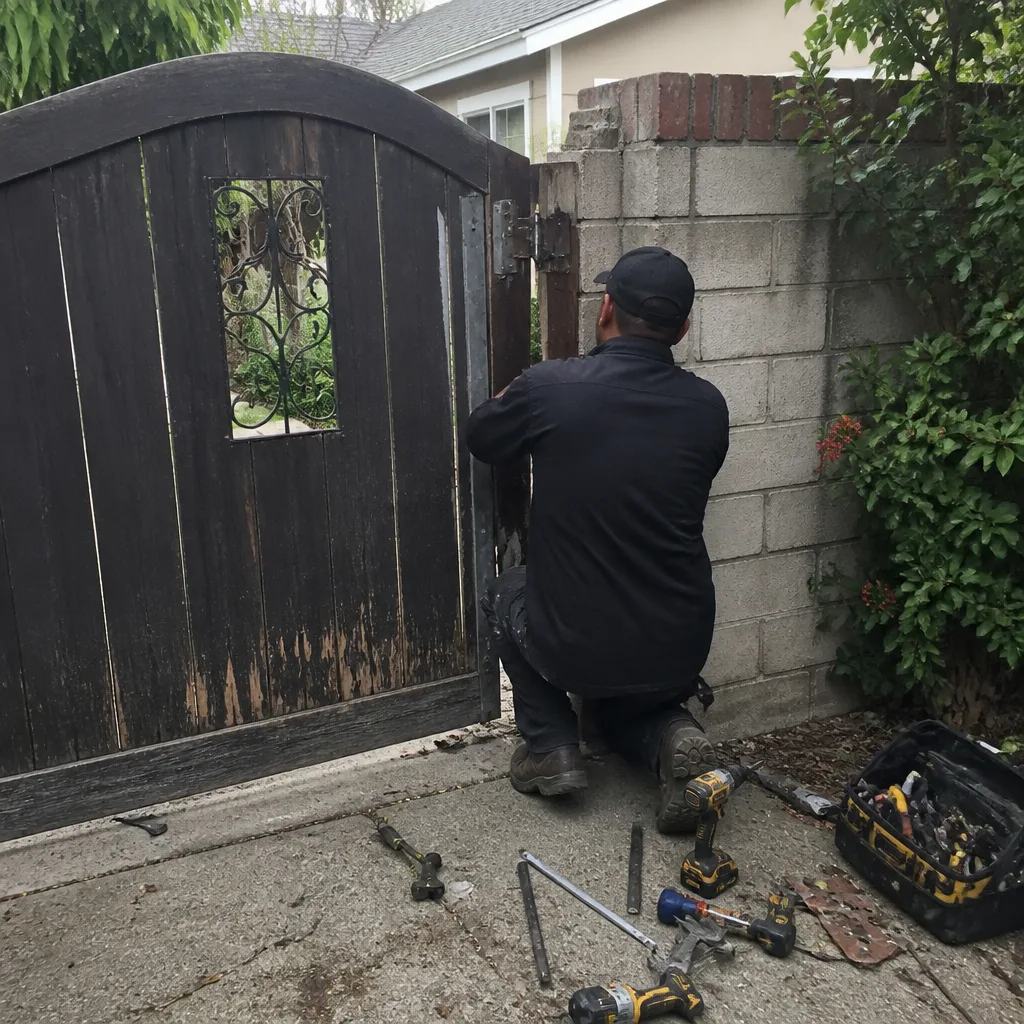 Before
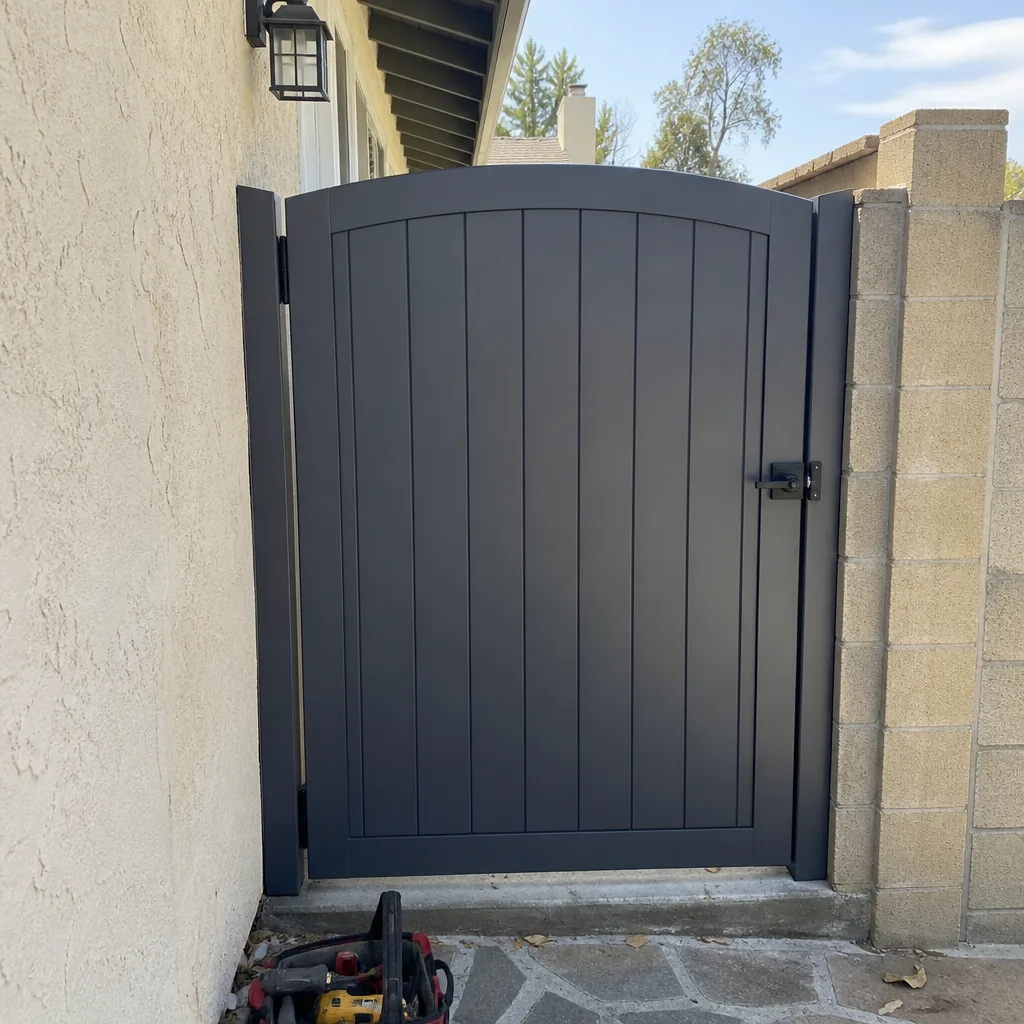 After